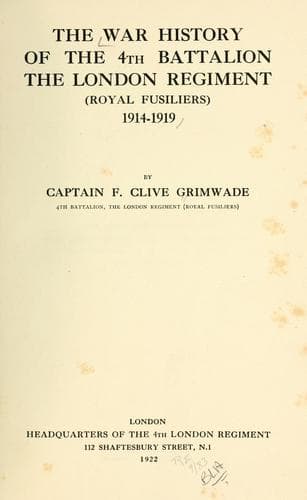
The War History of the 4th Battalion, the London Regiment (Royal Fusiliers), 1914-1919Grimwade, F. Clive
History
The War History of the 4th Battalion, the London Regiment (Royal Fusiliers), 1914-1919
Grimwade, F. Clive
Great Britain. Army. London Regiment. 4th (City of London) Battalion; World War, 1914-1918 -- Regimental histories -- Great Britain
On the evening of the 19th Brig.-Gen. Freyberg, V.C., D.S.O., was
seriously hit on his way to Battle Headquarters at Cheddar Villa; but
he insisted on remaining at duty, and directed operations from his
stretcher, though wounded in ten places, until after news of the
complete capture of the objective was received the next day, when his
removal was insisted upon by the A.D.M.S. who came forward to fetch
him. Command of the Brigade was taken temporarily by Lieut.-Col. Dann,
D.S.O.
The following decorations were awarded after this action: 2/Lieut. F.
W. Walker, the D.S.O.; Capts. A. Grover and S. Davis, and Lieut. E. H.
R. Altounyan, the M.C.; Sergt. Watson, Ptes. Bolton, Austin, Anthony
and Bull, the D.C.M.; and Sergts. H. O. Wilderspin and F. W. Yandle,
Ptes. J. W. Ling and A. Westcott, the M.M.
The casualties sustained during the action included: 2/Lieuts. H. N.
Bundle, E. R. Seabury and W. D. Warren, killed; 2/Lieut. F. B. Burd,
died of wounds; Capts. W. A. Stark, H. A. T. Hewlett and S. Davis,
M.C., 2/Lieuts. D. S. Boorman, M. C. (at duty), A. J. Angel, W. F.
Vines and A. C. Knight, wounded; and 60 N.C.O.'s and men killed, 176
wounded and 29 missing.
The 58th Division remained in line after this attack, and on the 26th
September took part in the third general attack which was delivered
by the Second and Fifth Armies on a front of some six miles, of which
the northern limit was the Divisional sector. The attack was delivered
by the 175th Brigade and a further considerable success gained, the
Divisional front having been carried forward in the operations since
the 19th a total distance of about 1600 yards.
On the 27th September, the 2/4th Londons moved to Brake Camp, in the
Vlamertinghe area. Two days were occupied in training here, during
which the area in which the Battalion was located suffered on the
night of the 28th/29th September the most prolonged and serious
bombing by enemy aircraft it ever experienced, the bombardment lasting
without cessation from 9 p.m. to 2 a.m. Fortunately no casualties were
sustained.
At Brake Camp the following joined the Battalion:
Capt. R. C. Dickins.
2/Lieuts. C. C. Gibbs, D. G. Spring, F. J. Jones, E. G. Gardner and
A. W. Dodds (21st Londons); and 2/Lieut. S. J. Richardson
(7th Londons).
250 N.C.O.'s and men.
Further casualties during September included Lieut., C. Potter and
2/Lieuts. O. H. Mattison and J. McDonald, to hospital.
2/Lieut. Cook was appointed to the 173rd L.T.M. Battery.
On the 30th September the 58th Division was withdrawn from the line and
concentrated as Corps reserve for rest in the Nordausques area (eight
miles north-west of St Omer), and the 2/4th Londons moved by rail from
Vlamertinghe to Zouafques where they went into billets on the 1st
October. The train was followed and bombed during the journey by German
airmen, 1 sergeant and 2 men being killed.
Public-domain text, read in full here on John Shaqi.
Reviews
Reviews
No reviews yet
Be the first to share your thoughts on this work.
Elsewhere in the archive
Join the Discussion
Join the discussion
Sign in to leave a comment or review.
Sign InorCreate an account