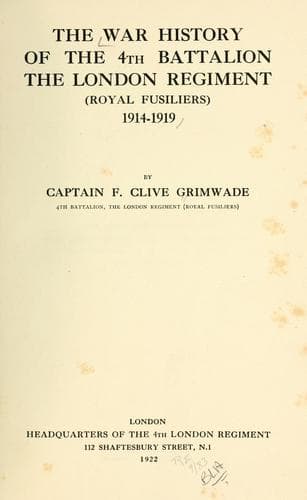
The War History of the 4th Battalion, the London Regiment (Royal Fusiliers), 1914-1919Grimwade, F. Clive
History
The War History of the 4th Battalion, the London Regiment (Royal Fusiliers), 1914-1919
Grimwade, F. Clive
Great Britain. Army. London Regiment. 4th (City of London) Battalion; World War, 1914-1918 -- Regimental histories -- Great Britain
During the period of the 58th Division's withdrawal from the line the
offensive was pressed forward under adverse conditions of weather.
The season was now becoming advanced and the condition of the ground
offered a far greater obstacle to our progress than the enemy's
resistance. Probably no series of battles of the whole war was waged
under such persistently adverse conditions, or imposed a greater
physical strain on the attacking troops. In every direction the
salient was by now a series of "shell hole lakes" the ground being
waterlogged and the mud more glutinous than ever. An increasing number
of casualties to men and beasts occurred through drowning in the shell
holes of this ghastly shell-battered inferno, but though the whole
forces of the elements seemed to be arrayed against us, advances of
enormous importance were achieved during the early part of October,
as a result of which the Allied positions were pushed forward to the
outskirts of Houthulst Forest, to the east of Poelcapelle and to within
2000 yards of Passchendaele.
The prolonged continuance of active operations was obviously becoming
increasingly difficult, but G.H.Q. was impelled to pursue the course
of this dreary offensive partly by reason of the serious situation
caused on the Italian front by the defeat of Caporetto at the end of
October, and partly by the need of containing as many German divisions
as possible during the preparations for the Cambrai battle, which were
not yet complete.
The 2/4th Londons remained at Zouafques training and reorganising for
over three weeks. Several drafts were received from the Base, which
together made the considerable addition of 244 N.C.O.'s and men to the
Battalion strength, thus bringing it above its numbers prior to the
action of the 20th September.
On the 15th October the Battalion was joined by 2/Lieut. H. G. Langton;
and by 2/Lieuts. H. A. Snell, J. R. Naylor and R. J. Richards (1st
Londons). During this period also 2/Lieuts. H. E. English and C. C. H.
Clifford were evacuated sick. Capt. S. H. Stedman was posted to the
173rd Brigade Labour Company at Louches.
On the 23rd October the 2/4th Londons returned by train to the
Vlamertinghe area and took over quarters in Siege Camp, moving the
following day to the concentration area on the canal bank, whence
the battle surplus under 2/Lieut. Askham left the Battalion for the
Divisional Depôt Battalion.
On the 25th October, Major W. A. Nunneley, second in command of the
Battalion since July 1916, fell sick and was evacuated to hospital, his
duties being taken over by the adjutant, Capt. A. Grover, M.C. Major
Nunneley was subsequently appointed to command the German officers'
Prisoners of War Camp at Donington Hall. Capt. Grover, M.C., was
succeeded in the Adjutancy by Lieut. F. W. Walker, D.S.O. On the 22nd
2/Lieut D. G. Spring was seconded to the XX Corps School as Instructor.
Public-domain text, read in full here on John Shaqi.
Reviews
Reviews
No reviews yet
Be the first to share your thoughts on this work.
Elsewhere in the archive
Join the Discussion
Join the discussion
Sign in to leave a comment or review.
Sign InorCreate an account