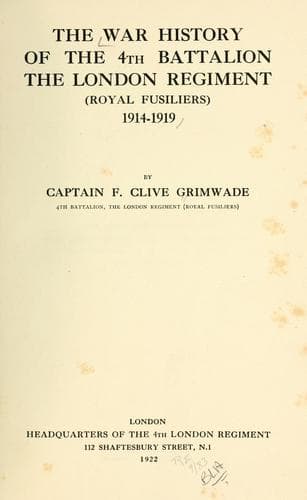
The War History of the 4th Battalion, the London Regiment (Royal Fusiliers), 1914-1919Grimwade, F. Clive
History
The War History of the 4th Battalion, the London Regiment (Royal Fusiliers), 1914-1919
Grimwade, F. Clive
Great Britain. Army. London Regiment. 4th (City of London) Battalion; World War, 1914-1918 -- Regimental histories -- Great Britain
The rain, which had started early in the day, was still falling when
the Battalion arrived at Doignies. The village was a good deal knocked
about, but shelter of a sort was found, and the Battalion was just
well off to sleep when it was turned out again to move nearer the line
for the purpose of taking over the British front line from the London
Scottish early next day. About midnight the Battalion got under way in
pitch darkness, and moving through Louverval reached its assembly area
near Piccadilly and about 500 yards in rear of the line by 4.10 a.m. on
the 23rd November. As soon as the growing daylight permitted, companies
resumed their advance and took over Rook, Rabbit and Herring Trenches
from the London Scottish, Headquarters occupying a sunken road north
of the wood surrounding Louverval Château. On relief the assaulting
companies of the London Scottish moved forward to continue the bombing
attack started by the 169th Brigade.
News of the operation was slow in coming through, but by 10.17 a.m.
a report reached Brigade that the attackers had been checked on
endeavouring to emerge from Tadpole Copse. This check was due to a
peculiar omission in the British trench maps, which had shown Tadpole
Copse on the crest of a spur, and dominating all the ground in its
immediate vicinity. It was found that between the Copse and the Inchy
Road was a narrow and sharply marked depression bordered by the
declivitous banks which abound in this undulating countryside. Beyond
this unsuspected valley the Inchy Road was on an eminence just as
prominent as the Tadpole Copse hill; and this position, held by the
enemy in great strength, enabled them to overlook completely all the
northern exits from the Copse. This valley, which played an important
part in the course of the battle, was found subsequently to be
correctly marked on German maps which were captured during the action.
After a stubborn fight the London Scottish overcame this obstacle
and pushed home their attack in the Hindenburg front trench almost as
far as Adelaide Street and in the support 100 yards beyond the Inchy
Road; while a subsidiary attempt was made, without success, to capture
the Factory between this point and Inchy. At these points the enemy
had constructed blocks which he held strongly against all attempts to
dislodge him. In the meantime the 169th Brigade had been bombing up
the communications leading back to the second system of the Hindenburg
lines, with the object of isolating Mœuvres, but the resistance met
with here was exceedingly stubborn.
Public-domain text, read in full here on John Shaqi.
Reviews
Reviews
No reviews yet
Be the first to share your thoughts on this work.
Elsewhere in the archive
Join the Discussion
Join the discussion
Sign in to leave a comment or review.
Sign InorCreate an account