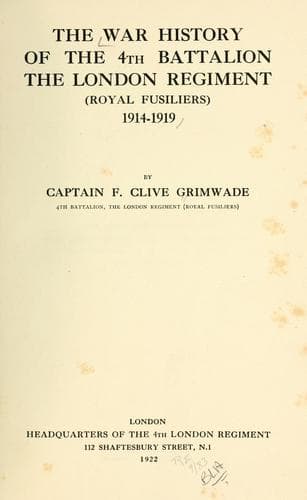
The War History of the 4th Battalion, the London Regiment (Royal Fusiliers), 1914-1919Grimwade, F. Clive
History
The War History of the 4th Battalion, the London Regiment (Royal Fusiliers), 1914-1919
Grimwade, F. Clive
Great Britain. Army. London Regiment. 4th (City of London) Battalion; World War, 1914-1918 -- Regimental histories -- Great Britain
The following day at an early hour the Flesquières obstacle was
overcome and the British line swept forward, the villages of Masnières,
Noyelles, Cantaing and Anneux being added to the bag, while on the
left Fontaine-Notre-Dame was entered and the line pushed up to the
southern edge of Bourlon Wood. On the left of the 36th the 169th
Brigade kept pace, one of their battalions occupying the first
Hindenburg trench about one of the roads forming the south-west exit of
Mœuvres, and beginning to bomb northwards.
The 21st November witnessed a further deep inroad into the Hindenburg
system. The 36th Division succeeded during the morning in penetrating
into Mœuvres but were not able to maintain their position. On the
extreme left the 169th Brigade continued their bombing attacks along
the enemy trenches, and were reported in the late afternoon as having
captured Tadpole Copse and the first and second Hindenburg trenches
beyond it as far as the Inchy Road.
* * * * *
In the Battalion at Frémicourt the 20th November passed without
incident, but all ranks awaited anxiously news of the battle, and
for the expected orders to move forward and join in the success. No
movement was made, however, and the day passed slowly, as such days of
keen expectancy always do.
The hour for general action by the 56th Division was approaching, and
the 1/4th Londons received orders at 3.30 p.m. on the 21st to move
forward with transport and stores to Lebucquière, which was reached at
8.15 p.m., accommodation being provided in Cinema Camp. The Battalion
was now prepared for action, and the nucleus personnel under Major
Phillips, the second in command (attached from Montgomery Yeomanry),
remained at Frémicourt.
Next morning the Battalion made all preparations for an early
participation in the fight and, in order to save fatigue to the men,
all battle impedimenta such as Lewis guns and magazines, bombs, tools
and wire cutters were sent on limbers to an open space near Doignies.
Shortly after midday the Battalion followed, arriving at Doignies
at 4 p.m., picking up its stores and bivouacking. In the meantime
Lieut.-Col. Marchment, M.C., accompanied by Capt. Maloney, the doctor,
rode forward to ascertain the situation from the London Scottish, who
were holding the old British front line opposite Tadpole Copse.
Public-domain text, read in full here on John Shaqi.
Reviews
Reviews
No reviews yet
Be the first to share your thoughts on this work.
Elsewhere in the archive
Join the Discussion
Join the discussion
Sign in to leave a comment or review.
Sign InorCreate an account