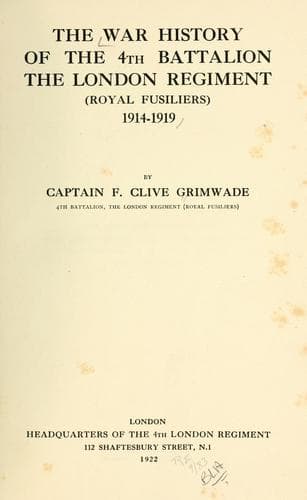
The War History of the 4th Battalion, the London Regiment (Royal Fusiliers), 1914-1919Grimwade, F. Clive
History
The War History of the 4th Battalion, the London Regiment (Royal Fusiliers), 1914-1919
Grimwade, F. Clive
Great Britain. Army. London Regiment. 4th (City of London) Battalion; World War, 1914-1918 -- Regimental histories -- Great Britain
14 Platoon, 2/Lieut. E. Petrie, Bombers, Rifle Grenadiers, Riflemen
(carrying); 13 Platoon, 2/Lieut. C. W. Rowlands, with sections
in same order.[5] Lewis gun sections took up a position near our
blocks so as to fire along the trench and to prevent any movement
in the open. Company Headquarters moved with the leading platoon.
For about 50 yards very little opposition was met with but the
leading bombing section was then held up by stick bombs and
suffered eight casualties, which included the leading bombers. To
overcome this check fire was opened for several minutes with No. 23
and No. 24 Rifle Grenades, and the trench was searched forward for
about 100 yards. The shooting was very accurate and the enemy were
driven back with the loss of about 5 men killed. The advance was
continued by bounds of from 20 to 40 yards under cover of salvoes
of rifle grenades. The first two deep dugouts were unoccupied. The
third and fourth were not immediately searched but sentries were
posted. It was thought that some of the C Company men who had been
wounded the previous day might still be down there. The small C.T.
(about 100 yards from the Quadrilateral) was blocked about 120
yards up. At the entrance a good deal of bombing was overcome. This
is a shallow trench and the far end under water. Further delay was
caused by the third and fourth dugouts which were found to contain
21 of the enemy. These were finally cleared. Several were killed
and the remainder badly wounded and captured. The company then
pushed forward to trench junction at E 13 c. 15.75 (objective) and
reached it about 2.45 p.m. The Lewis gun sections were brought up
and placed in suitable positions to protect a further advance and
also the blocking party in the small C.T. None of the Rangers were
encountered and the trench appeared unoccupied, but bombing was
thought to be heard about 300 yards further along.
[5] Companies were still organised in two platoons owing to their
reduced strength, which had not been made good since the third battle
of Ypres.
Public-domain text, read in full here on John Shaqi.
Reviews
Reviews
No reviews yet
Be the first to share your thoughts on this work.
Elsewhere in the archive
Join the Discussion
Join the discussion
Sign in to leave a comment or review.
Sign InorCreate an account