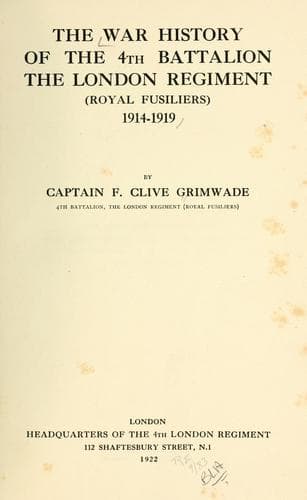
The War History of the 4th Battalion, the London Regiment (Royal Fusiliers), 1914-1919Grimwade, F. Clive
History
The War History of the 4th Battalion, the London Regiment (Royal Fusiliers), 1914-1919
Grimwade, F. Clive
Great Britain. Army. London Regiment. 4th (City of London) Battalion; World War, 1914-1918 -- Regimental histories -- Great Britain
A small block was made in this trench about 30 yards from the
junction. The enemy was now observed leaving the trench and
crawling over the open towards the bank at D 18 d. 90.98 (in the
unsuspected valley). Heavy rifle fire was opened and at least
30 of the enemy killed. Few, if any, got over the bank. As the
trench beyond the objective appeared to be unoccupied a party of
12 including O.C. Company, 2/Lieut. Rowlands, Sergts. Norris and
Arklay, moved on up the trench. No fire was opened and silence was
maintained. In the next bay past the trench at E 13 c. 00.85 (50
yards beyond the objective) two men were seen firing a machine-gun
which was mounted on the parapet and aimed down the bank (in the
valley). This was rushed.... The gun was dismounted and brought
in. Other guns were heard firing and two more were seen (at points
farther along the trench in the valley described in the report
by map reference). Two parties under Sergts. Norris and Arklay
moved round to a point from which fire could be brought to bear.
The crews of two men to each gun were killed and the guns brought
in. O.C. Company and Sergt. Norris continued to advance along the
trench and up to the top of the bank. Heavy bombing could be seen
in Tadpole Lane and in the front line towards the Inchy Road.
Further advance was prevented by the fire of our own guns firing
on the trench in response to S.O.S. signal which had been sent up
from the front line. The trench was very full of dead, both of
the London Scottish and of the enemy. It was impossible to walk
without treading on them. As our barrage continued the party moved
back to our original objective and blocks were made at this trench
junction. The remainder of the party carried back four wounded
London Scottish, who were found in the open near the bank. Later in
the evening when our barrage was discontinued an attack was made
on our block. The enemy was quickly silenced. At 11 p.m. D Company
were relieved by A Company.
A very successful operation, and a modest account of it by Duthie,
whose personality and leadership was an important factor in the result
achieved. The two men in charge of the first gun captured were shot
by Duthie with his revolver. The resistance offered to the Rangers
was stubborn, and but for their inability to advance it is possible a
considerable success might have been achieved, since the barrage put
down by our guns, in response to the Rangers' S.O.S., had the effect of
shelling Duthie out of part of his gains.
The remainder of the day was inactive, no further fighting taking place
till about 11.30 a.m. on the 26th, when once more the enemy attempted
to force B Company's position in the communication trench. The company,
however, repeated its gallantry of the former occasion, and the enemy
retired later without having gained any success.
Public-domain text, read in full here on John Shaqi.
Reviews
Reviews
No reviews yet
Be the first to share your thoughts on this work.
Elsewhere in the archive
Join the Discussion
Join the discussion
Sign in to leave a comment or review.
Sign InorCreate an account