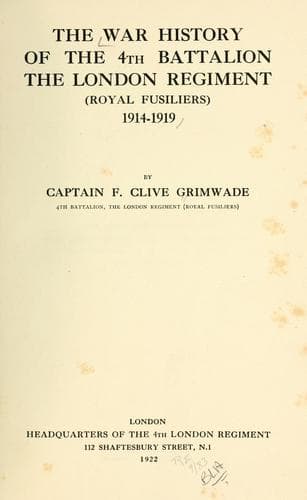
The War History of the 4th Battalion, the London Regiment (Royal Fusiliers), 1914-1919Grimwade, F. Clive
History
The War History of the 4th Battalion, the London Regiment (Royal Fusiliers), 1914-1919
Grimwade, F. Clive
Great Britain. Army. London Regiment. 4th (City of London) Battalion; World War, 1914-1918 -- Regimental histories -- Great Britain
At 10.45 a.m. the S.O.S. signal went up all along the line and the
enemy attacked in dense formation under a heavy barrage. The Battalion
stood to arms all day but was not required, for the gallant defence of
the units in the line this day was one of the greatest achievements of
the 56th Division. The enemy's attack was pressed with vigour and at
one time he had driven a wedge into the Hindenburg lines and divided
the London Scottish, who were still in the line, from the 2nd Londons.
The position, however, was defended tenaciously and at the end of the
day the whole of the Division's gains in the Hindenburg front line
were maintained, while the heaps of enemy dead outside the trenches
testified to the severity of the check which he had suffered.
That night the Battalion was called on for particularly active
patrolling as it was anticipated that the enemy would renew his attempt
on the Divisional front. The whole resources of the Division were
drawn upon to meet any renewed enemy action, and Lieut.-Col. Marchment
had under him for defensive purposes, in addition to the Battalion,
a company of the 5th Cheshires, a company of the 7th Middlesex, the
512th Field Company, R.E., and two sections of the 416th Field Company,
R.E. The Engineers were employed in digging fresh redoubts in dead
ground to the rear of the defensive flank line, while the infantry
companies were kept as a reserve at Battalion Headquarters. No further
action occurred until the afternoon of the 1st December when a fresh
concentration of enemy forces about 3.30 p.m. was crushed by our guns.
The Division had now well earned a rest, and warning was received
on the 1st December that it would be relieved by the 51st Division
immediately. The relief began at 7 p.m. that evening, the Battalion
handing over its lines to the 6th Black Watch. It was evident that the
incoming troops had been pushed forward hurriedly, for the relieving
battalion arrived without Lewis guns or shrapnel helmets, and with
the officers wearing slacks, just as they had risen from dinner. The
relief took a long while to effect, and it was not until 4 a.m. on
the 2nd that Lieut.-Col. Marchment handed over command of the sector.
On relief the Battalion withdrew to billets in Beugny, but at 11 a.m.
the rearward march was continued to Beaulencourt which was reached by
4 p.m., quarters being allotted in the camp that the Battalion had
occupied on the 30th August.
While at Beaulencourt the Battalion received congratulatory messages
which had been issued to Brigade by the Corps and Divisional commanders
on the part played in the battle.
The following day the Battalion entrained at Frémicourt for the Arras
area, reaching Beaumetz-les-Loges at 12.30 p.m., whence it marched to
billets in Simencourt.
The honours awarded for services rendered in the Battle of Cambrai were
as follows:
D.S.O.--Capt. A. M. Duthie.
M.C.--2/Lieuts. C. W. Rowlands and E. L. Mills.
Public-domain text, read in full here on John Shaqi.
Reviews
Reviews
No reviews yet
Be the first to share your thoughts on this work.
Elsewhere in the archive
Join the Discussion
Join the discussion
Sign in to leave a comment or review.
Sign InorCreate an account