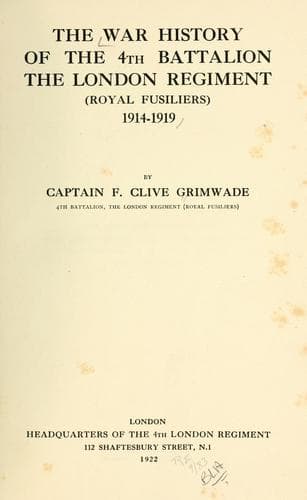
The War History of the 4th Battalion, the London Regiment (Royal Fusiliers), 1914-1919Grimwade, F. Clive
History
The War History of the 4th Battalion, the London Regiment (Royal Fusiliers), 1914-1919
Grimwade, F. Clive
Great Britain. Army. London Regiment. 4th (City of London) Battalion; World War, 1914-1918 -- Regimental histories -- Great Britain
At midnight on the 24th November the 56th Division had passed from the
IV to the VI Corps. Its position at the conclusion of the offensive
operations was one of almost dangerous extension. It had captured and
was holding over a mile of the Hindenburg line. Its right flank was
not secure so long as Mœuvres remained in the enemy's hands; its left
flank on the Tadpole Copse spur was exposed and subject to constant
counter-attacks. Two of its brigades were involved in this fighting
and in holding a defensive flank of 2000 yards, while the remaining
brigade, the 167th, was responsible for a frontage in the old British
line of 5500 yards, and had in addition to supply a battalion each
night for consolidation of the captured position. It was thus unable
to provide relief for the troops who had been fighting, and was
without any reserve for use in case of emergency. Representations
made by General Dudgeon to the Corps Commander as to the weakness of
his position resulted in a battalion of the 3rd Division being at
once placed at the disposal of the 167th Brigade for counter-attack
purposes. This temporary relief was extended a few days later, and by
the 29th the whole of the 167th Brigade had been relieved by troops of
the 3rd Division and was withdrawn at Frémicourt in Divisional reserve,
with two of its battalions lent temporarily to the 168th Brigade.
The three days following relief were spent by the Battalion in support
in providing carrying and working parties in the front line and burying
parties for the fallen. On the 29th a slight side step to the left
was made so that the Battalion's right flank rested on Piccadilly and
it became responsible for the defensive flank. A considerable amount
of work had been done in this quarter, and the flank was now provided
with a continuous belt of wire and a chain of inter-supporting posts.
A communication trench had been dug from the old line across No Man's
Land to the Hindenburg line parallel to Piccadilly, a distance of some
1300 yards, and from this T-head trenches had been sapped forward
facing north. The defensive flank positions were only occupied at
night, the trench garrison taking two companies, A and B, while C and
D Companies provided patrols along the wire to prevent any attempts of
the enemy to turn the position.
The 29th November passed quietly though a good deal of movement was
observable in rear of the enemy's lines, so that his serious attack of
the following day was not entirely unexpected.
From the Battalion's position an extensive view was obtainable over the
whole terrain as far as Bourlon Wood, and early on the 30th a strong
concentration of the enemy's forces was clearly visible north and east
of Mœuvres.
Public-domain text, read in full here on John Shaqi.
Reviews
Reviews
No reviews yet
Be the first to share your thoughts on this work.
Elsewhere in the archive
Join the Discussion
Join the discussion
Sign in to leave a comment or review.
Sign InorCreate an account