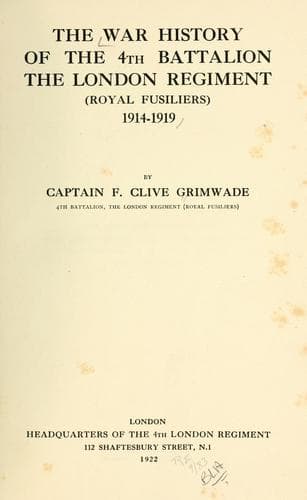
The War History of the 4th Battalion, the London Regiment (Royal Fusiliers), 1914-1919Grimwade, F. Clive
History
The War History of the 4th Battalion, the London Regiment (Royal Fusiliers), 1914-1919
Grimwade, F. Clive
Great Britain. Army. London Regiment. 4th (City of London) Battalion; World War, 1914-1918 -- Regimental histories -- Great Britain
Five uneventful days passed in the Oppy trenches. On the whole the
enemy displayed little activity beyond occasional retaliation to our
continuous and systematic bombardments, which were by day and night
directed against the enemy's "weak spots." At night the Bosche showed
signs of considerable nervousness. A good deal of progress was made
with the Brigade programme of trench and wiring work, which was carried
on in intensely cold weather, and on the 23rd the Battalion once more
exchanged with the Rangers and withdrew to Brigade support.
In the support area Headquarters and B Company (Spicer) were in a
30-foot railway cutting in rear of Bailleul, while A (H. N. Williams),
C (Barkworth) and D (Cooper) were in the Red line. Christmas day,
which was fortunately not marked by hostile activity, was spent in
these positions and by means of numerous small parties in the Red
line the troops were able to get as much enjoyment out of it as the
circumstances permitted, but the festivity was rather damped by the
death of 2/Lieut. E. L. Stuckey, a keen and promising officer, who was
killed by a stray shell in the Red line.
Late on Christmas evening the enemy carried out a hurricane bombardment
on the front line posts, and during the last day of the year showed
some disposition to increase his harassing fire on our back areas.
On the 28th December the 167th Brigade relieved the 168th, which
withdrew in Divisional reserve to the Marœuil area, the Battalion being
billeted at St Aubin, where five days of training and refitting were
obtained. The New Year was celebrated by carrying out the arrangements
which had originally been made for Christmas, and after a quite
pleasant interlude the Battalion moved on the 3rd January 1918, into
the right sector of the Divisional front at Gavrelle, relieving the
Queen's Westminsters. The weather was now intensely cold and the ground
was covered with snow, which effectively stopped any attempts at active
work. The tour of duty passed quietly and without any casualties,
though the enemy's artillery and trench mortar fire continued to show
an increase in volume, and on both sides aircraft activity developed.
The 62nd Division now took over the Division's sector, and on the 6th
January the 56th Division passed into G.H.Q. reserve at forty-eight
hours' notice to move. The Battalion handed over its trenches to the
2/4th K.O.Y.L.I. and moved to billets at Marœuil, continuing its route
on the 7th to Monchy-Breton (near St Pol), where it arrived in billets
at 4 p.m.
A great deal of useful training was carried out at Monchy-Breton,
but the incident which probably did as much good to the Battalion
as any, was the formation by Lieut. Faulkner, the quartermaster, of
an orchestra which was an enormous success from its inception, and
maintained its reputation until the end of the War. The orchestra
included the following:
Public-domain text, read in full here on John Shaqi.
Reviews
Reviews
No reviews yet
Be the first to share your thoughts on this work.
Elsewhere in the archive
Join the Discussion
Join the discussion
Sign in to leave a comment or review.
Sign InorCreate an account