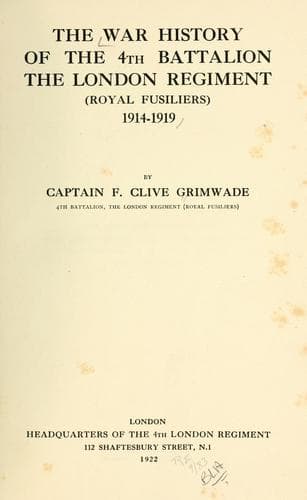
The War History of the 4th Battalion, the London Regiment (Royal Fusiliers), 1914-1919Grimwade, F. Clive
History
The War History of the 4th Battalion, the London Regiment (Royal Fusiliers), 1914-1919
Grimwade, F. Clive
Great Britain. Army. London Regiment. 4th (City of London) Battalion; World War, 1914-1918 -- Regimental histories -- Great Britain
'Cellos Ptes. Montague and Stone.
Violins Ptes. Barton, Fairman, Perrin and Cornell.
Cornets Sergt. Fulford and Pte. Stevens.
Trombones Sergt. Grimston and Pte. Westerman.
Clarionets Sergt.-Dr Ingham and Pte. Spooner.
Horn Pte. Cuffe.
Drum Pte. Smith.
Harmonium L.-Corpl. Weekes.
The numerous concerts given by this excellent band, which was really
well trained by the quartermaster, afforded real pleasure, not only
to the Battalion and to other units of the Division, but also to the
French inhabitants of the various villages in which the Battalion found
temporary homes.
During December and January the Battalion was joined by 2/Lieuts. H. T.
Hannay and H. O. Morris, and by 2/Lieut. A. E. Hanks (13th Londons),
while Capt. G. E. Stanbridge was granted an exchange to England for six
months' duty at home, after having been in France since March 1916.
By this time the possibilities of a German offensive had developed into
a practical certainty, and all training was directed towards methods
of defence and counter-attack. Much attention was paid to musketry and
Lewis gun training. The importance of the rifle and bayonet as the
infantry weapon _par excellence_ was once more being realised, and the
bomb and rifle grenade, which in 1916 and 1917 had to a large extent
ousted the rifle from its proper function, were again recognised to be
only subsidiary aids in certain circumstances, so that full advantage
was eagerly taken of the chance to ensure that all ranks were "handy"
with their rifles.
The defensive systems in the area lately occupied by the Division
still needed a vast amount of work to bring them to a condition to
resist a serious attack, and accordingly throughout the period spent
in G.H.Q. reserve each brigade of the Division supplied one battalion
for work in the forward area under the Chief Engineer XIII Corps. The
Battalion's turn for this duty came after seventeen days of training at
Monchy-Breton, and on the 24th January it moved forward, railing from
Tincques to Ecurie, and was accommodated at Stewart Camp, Roclincourt,
the transport lines being stationed at Marœuil. Every available man
was now put to work in one or other of the large parties which were
supplied daily for the R.E.'s, the principal tasks which fell to the
Battalion's lot being the wiring of the Green line and the construction
of cable trenches (_i.e._ narrow deep trenches in which telegraph
cables were buried to minimise the risk of their destruction by shell
fire) in the forward area by night. The severity of the winter had now
given place to thaw; the weather was warm for the time of year and a
good deal of rain fell.
This duty continued till the end of January, when the Battalion was
relieved and returned to the reserve area by train from Ecurie to
Tincques, marching thence to billets at Magnicourt, which were reached
on the 1st February.
Public-domain text, read in full here on John Shaqi.
Reviews
Reviews
No reviews yet
Be the first to share your thoughts on this work.
Elsewhere in the archive
Join the Discussion
Join the discussion
Sign in to leave a comment or review.
Sign InorCreate an account