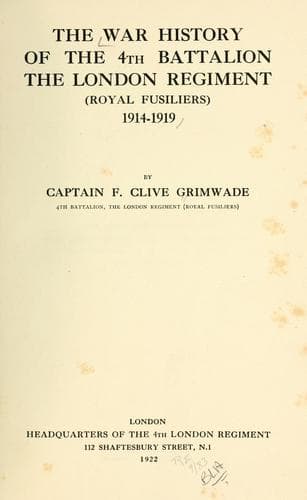
The War History of the 4th Battalion, the London Regiment (Royal Fusiliers), 1914-1919Grimwade, F. Clive
History
The War History of the 4th Battalion, the London Regiment (Royal Fusiliers), 1914-1919
Grimwade, F. Clive
Great Britain. Army. London Regiment. 4th (City of London) Battalion; World War, 1914-1918 -- Regimental histories -- Great Britain
An extensive reorganisation was now effected throughout the British
armies in France. The ever-dwindling supply of reinforcements from
home, due in part to failing resources in man-power and partly to
the retention in England of large defence forces which were held in
readiness against a possible German invasion, had caused the numbers
in infantry battalions throughout the Army to sink dangerously below
full strength. In the 1/4th Londons the casualties of Ypres and
Cambrai in 1917 had never been balanced by reinforcements, and this
was typical of the condition of affairs in every unit which had been
heavily engaged in the preceding six months. The decision arrived at,
therefore, was to reduce all Brigades to a three, instead of a four,
battalion establishment, and this was carried out by disbanding one
battalion per brigade and dividing out its strength among the three
battalions which were retained. Inevitably such drastic action caused
bitter disappointment among the battalions which had the misfortune to
be selected for disbandment, and _esprit de corps_ received temporarily
a severe check. In the 56th Division the 3rd (Royal Fusiliers), 9th
(Queen Victoria's) and 12th (Rangers) Battalions were reduced to
cadre strength and transferred to the 58th Division, so that from the
beginning of the month of February 1918 the infantry of the Division
consisted of:
167TH BRIGADE--1st London Regiment (Royal Fusiliers).
1/7th Middlesex Regiment.
1/8th do.
168TH BRIGADE--1/4th London Regiment (Royal Fusiliers).
1/13th do. (Kensingtons).
1/14th do. (London Scottish).
169TH BRIGADE--1/2nd London Regiment (Royal Fusiliers).
5th do. (London Rifle Brigade).
1/16th do. (Queen's Westminster Rifles).
The Battalion received through these changes about 150 N.C.O.'s and
men from the 9th Londons, 50 from the 3rd Londons and 60 from the
2/1st Londons, who had been disbanded from the 58th Division. Four
subalterns also came to the Battalion as follows: Lieuts. G. G. Lewis
and F. G. Athey from 2/1st Londons, H. F. Dade from 3rd Londons and
W. G. Hook from 9th Londons. The new arrivals naturally felt sore at
first at the disappearance of their own units, but, being all good
sportsmen, accepted the inevitable, and rapidly settled down in the
1/4th Battalion. This acquisition of strength enabled the Battalion
organisation of companies to be expanded to a three-platoon basis
instead of the two-platoon system which had been in force since August
1917.
At Magnicourt a week's useful training was effected, in which the
reorganisation necessary in consequence of the above changes figured
largely. The Battalion was joined by 2/Lieuts. R. E. Campkin, C. H.
Board, T. H. Mawby and G. R. Pitman.
Public-domain text, read in full here on John Shaqi.
Reviews
Reviews
No reviews yet
Be the first to share your thoughts on this work.
Elsewhere in the archive
Join the Discussion
Join the discussion
Sign in to leave a comment or review.
Sign InorCreate an account