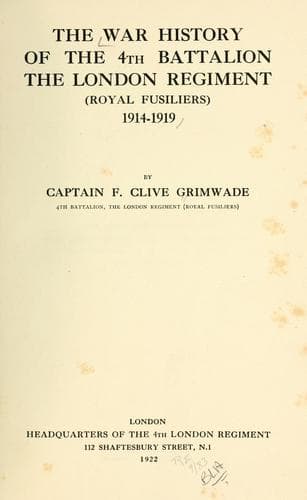
The War History of the 4th Battalion, the London Regiment (Royal Fusiliers), 1914-1919Grimwade, F. Clive
History
The War History of the 4th Battalion, the London Regiment (Royal Fusiliers), 1914-1919
Grimwade, F. Clive
Great Britain. Army. London Regiment. 4th (City of London) Battalion; World War, 1914-1918 -- Regimental histories -- Great Britain
From the 22nd to the 27th the Battalion was once more in the trenches
for another quiet tour of duty, and on the latter date it withdrew to
Roclincourt West Camp in Divisional reserve. The lack of activity at
this period is evidenced by the fact that only two men were wounded
during the month of February.
Attention was now fixed solely on the coming offensive, to meet which
preparations were being pushed forward with thoroughness. Additional
firesteps were constructed in the trenches and the already formidable
wire was further strengthened.
From this date forward every tour in the trenches or in Brigade support
was passed by platoons in exactly the same position, so that every man
might, whenever the offensive should be launched, be well acquainted
with his position.
The five days at Roclincourt West Camp were succeeded by a short period
in Brigade support, in which position the Battalion relieved the
Kensingtons on the 5th March. The tour of duty passed quietly with the
exception of a somewhat severe enemy bombardment with gas shell on the
evening of the 8th. Early on the morning of the 9th the Kensingtons
carried out an excellent raid on the enemy lines north of Oppy, in
the course of which about 20 Germans were killed and 4 brought back
as prisoners. The raiding party was under Lieut. Lester, M.C. (since
killed), commissioned from the 4th Londons. The identification obtained
was normal, that is, the prisoners belonged to the German regiment
which was believed to be opposed to us. These captures elicited
information that the offensive was imminent, and this, combined with
unmistakable signs of enemy activity, such as extensive road repairs,
clearing and repairing enemy trenches formerly derelict, and so forth,
left no room for doubt that the Germans' great effort could not be long
delayed. Thenceforward extreme vigilance was exercised all along the
line.
II. _The Reserve Battalion_
Shortly after the reconstruction of the 1st London (Reserve) Brigade,
which resulted in the 3rd (Reserve) Battalion being made the
draft-finding unit for both the 3rd and the 4th London Regiments, the
Brigade was moved from its camps at Hurdcott and Fovant to billets in
various watering places on the South Devon coast. The 3rd Battalion
was fortunate enough to be allotted to Torquay, where it took up
its new quarters in December 1916. As a military station Torquay
was, of course, not so desirable as Hurdcott. In the first place,
the scattering of untrained troops in billets greatly increased the
difficulty of disciplinary control, while training grounds were
farther removed and somewhat inadequate. In spite of these undoubted
disadvantages, however, the change from the bitter searching winds of
"The Plain" in winter time to the more genial climate of South Devon
was universally welcomed, and the Battalion lived for some weeks in
considerable comfort.
Public-domain text, read in full here on John Shaqi.
Reviews
Reviews
No reviews yet
Be the first to share your thoughts on this work.
Elsewhere in the archive
Join the Discussion
Join the discussion
Sign in to leave a comment or review.
Sign InorCreate an account