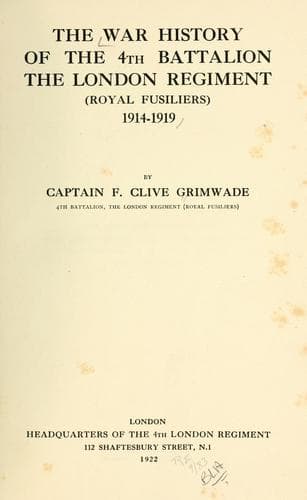
The War History of the 4th Battalion, the London Regiment (Royal Fusiliers), 1914-1919Grimwade, F. Clive
History
The War History of the 4th Battalion, the London Regiment (Royal Fusiliers), 1914-1919
Grimwade, F. Clive
Great Britain. Army. London Regiment. 4th (City of London) Battalion; World War, 1914-1918 -- Regimental histories -- Great Britain
The Brigade was now under command of Brig.-Gen. Howell, who at the
outbreak of war had commanded the l/3rd Londons, Col. Godman having
returned to the Scots Guards on the Somme.
Life in the Reserve Battalion at Torquay proceeded on very much the
same routine as had obtained at Hurdcott, and an attempt at describing
it in detail would only be wearisome. Once again the instructional
staff had to face the "spade work" of training raw recruits, since the
drain on the Battalion's resources during the Somme battles had denuded
it of trained soldiers, and a fresh batch of recruits now filled its
ranks.
A further modification in training organisation took place about
this time, and we may refer shortly to this as it affected the
functions of training battalions considerably. This modification lay
in the establishment of "Command Depôts" which were formed for the
reception from hospital of officers, N.C.O.'s and men returned from
the Expeditionary Force who were not yet physically fit to return to
their respective units. At a stage in their convalescence, in which
their retention in hospital as in-patients was no longer required,
such men were sent to their Command Depôt for light exercise in
walking, physical training and so on, and for such local treatment as
their individual cases necessitated. N.C.O.'s and men remained in the
Depôt until their recovery was complete, when they were despatched to
their training reserve units for a short "smartening-up" course of
instruction before being once more sent overseas. The Command Depôts
thus relieved training battalions of a great deal of medical and
convalescent work for which they were neither equipped nor suitable,
and also ensured that the staff of instructors in the training
battalions were engaged for the minimum of time in "brushing-up" the
trained men prior to their return to France, whereby they were enabled
to devote the maximum of attention to the recruits. The Guards and the
London Regiment were amalgamated for the purpose of a Command Depôt,
and this was located at Shoreham-by-Sea, Sussex. Shortly after its
formation, Major G. H. M. Vine was appointed from the Reserve Battalion
to the Permanent Staff of the Depôt.
In January 1917, Major L. T. Burnett joined the Reserve Battalion from
sick leave and was appointed second in command, a position which he
continued to fill until the following July, when he was transferred to
the War Office.
The South Devon station was retained for only a comparatively short
period and in April the Brigade moved again, this time to Blackdown,
in the Aldershot Command. Blackdown is some seven miles north of
Aldershot, and is one of the many pine-and heather-covered hills in
which the district abounds. Most of the barracks at this Station were
hutted camps, but the 3rd Battalion was fortunate in being sent to
Dettingen, a pre-war permanent barracks in which it was exceedingly
comfortable.
Public-domain text, read in full here on John Shaqi.
Reviews
Reviews
No reviews yet
Be the first to share your thoughts on this work.
Elsewhere in the archive
Join the Discussion
Join the discussion
Sign in to leave a comment or review.
Sign InorCreate an account