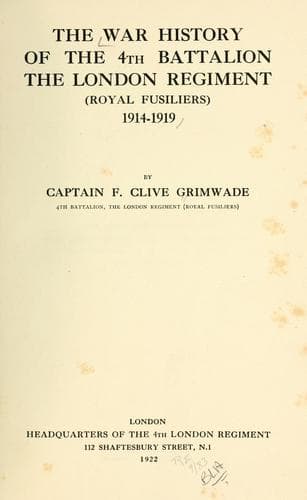
The War History of the 4th Battalion, the London Regiment (Royal Fusiliers), 1914-1919Grimwade, F. Clive
History
The War History of the 4th Battalion, the London Regiment (Royal Fusiliers), 1914-1919
Grimwade, F. Clive
Great Britain. Army. London Regiment. 4th (City of London) Battalion; World War, 1914-1918 -- Regimental histories -- Great Britain
The state of affairs was indeed critical and a grave crisis in the
War was approaching. Some slight account of the general conditions
which had brought this about has already been attempted, and there is
no occasion now to recapitulate the main factors of the situation in
which the Allies found themselves. We must, however, point to one or
two conditions especially attaching to the British front which had a
pre-eminent influence on what followed.
The gradual and ever-increasing numerical preponderance of the Germans
on the British front has been referred to; translated into numbers the
position may be better appreciated. During the period from the 1st
November 1917 to the 21st March 1918, the number of German divisions
on the Western front rose steadily from 146 to 192, an increase of
46, against which the total number of British divisions in France
was but 58, and these sadly depleted in numbers. The question of the
falling off in the numbers of reinforcements sent to France at this
period has become the subject of an embittered controversy to which we
do not propose to offer any contribution. We are, however, concerned
in pointing to the result, whatever the cause, of this growing
numerical disparity, which was to confront G.H.Q. with a most anxious
problem. The British front was now some 125 miles long, and a glance
at any war map will show that the general trend of the front was in a
north-westerly direction, _i.e._ near its northern extremity the line
ran comparatively close to the sea. In other words, the space available
for manœuvre in the event of a considerable break-through by enemy
forces was dangerously small in the vital neighbourhood of the Channel
Ports; and a successful German offensive in this region might have the
effect of rolling up our forces against the sea. In the south the space
between the lines and the sea was greater, but a large enemy success in
the southern area also had serious possibilities as it might entail the
complete isolation of the British Armies from the French.
Public-domain text, read in full here on John Shaqi.
Reviews
Reviews
No reviews yet
Be the first to share your thoughts on this work.
Elsewhere in the archive
Join the Discussion
Join the discussion
Sign in to leave a comment or review.
Sign InorCreate an account