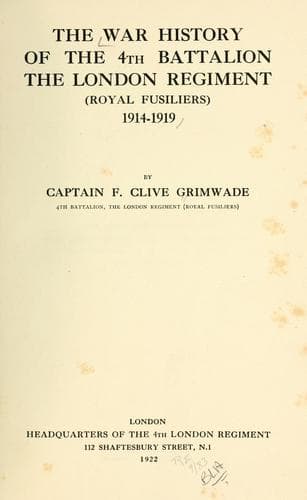
The War History of the 4th Battalion, the London Regiment (Royal Fusiliers), 1914-1919Grimwade, F. Clive
History
The War History of the 4th Battalion, the London Regiment (Royal Fusiliers), 1914-1919
Grimwade, F. Clive
Great Britain. Army. London Regiment. 4th (City of London) Battalion; World War, 1914-1918 -- Regimental histories -- Great Britain
The southward move of Gough's Fifth Army was for the purpose of
extending the British lines into an area hitherto occupied by
the French. Between the 10th January and the 3rd February 1918 a
considerable sector, extending from the River Omignon north of St
Quentin to Barisis, in the Forêt de St Gobain south of La Fère, was
taken over from the French. The responsibility for the whole of this
line, some thirty miles long, in addition to about twelve miles from
Gouzeaucourt to the Omignon, hitherto held by Byng's Third Army, fell
upon Gough.
The 58th Division was at first in reserve and was billeted in the
Amiens area, the 2/4th Londons being quartered on the evening of the
22nd January at Thézy-Glimont, a pleasant village near the confluence
of the Avre with the Noye, about eight miles south-east of Amiens,
where French pre-war civilisation was still almost untouched. It is
needless to remark how delightful to all ranks were these peaceful
surroundings after the ghastly shell-torn swamps of Poelcapelle. About
a fortnight passed at Thézy-Glimont in the usual routine of training,
during which one or two small drafts joined the Battalion. Lieut. B.
Rivers Smith left the Battalion on the 1st February for six months'
duty in England.
The most important feature of the rest period was the reorganisation of
Divisions on a ten-battalion basis,[6] of which a note has been given
in the preceding chapter. In the 58th Division, as in the 56th, the 4th
London Battalion was selected for continued existence, and at the end
of January the 2/4th Battalion was strengthened by the transference
from the disbanded 2/1st Londons of 10 officers and 221 other ranks.
The officers who joined from the 2/1st Londons were Capt. W. D. Ramsey;
Lieuts. W. C. Morton, G. J. L. Menges, W. B. Evans; 2/Lieuts. R. H. J.
Mendl, A. Woodington, C. J. C. Wildman, W. H. Parslow, S. H. E. Crane
and H. W. Durlacher. After the reorganisation the infantry of the
Division comprised the following units:
[6] Three Brigades of three battalions each, and one pioneer battalion.
173RD BRIGADE--2/2nd London Regiment (Royal Fusiliers).
3rd " " " "
2/4th " " " "
174TH BRIGADE--2/6th London Regiment (Rifles).
7th " "
8th " " (Post Office).
175TH BRIGADE--9th London Regiment (Queen Victoria's Rifles).
10th " " (Hackney).
12th " " (Rangers).
Before the Division left the Amiens area the imminence of a German
offensive was a matter of common knowledge to all ranks, and so
impressed with the seriousness of the situation was the High Command,
that on the 5th February a most inspiring message from General Gough
was conveyed in a lecture by the Brigadier, to all officers, warrant
officers and sergeants of the Brigade.
Public-domain text, read in full here on John Shaqi.
Reviews
Reviews
No reviews yet
Be the first to share your thoughts on this work.
Elsewhere in the archive
Join the Discussion
Join the discussion
Sign in to leave a comment or review.
Sign InorCreate an account