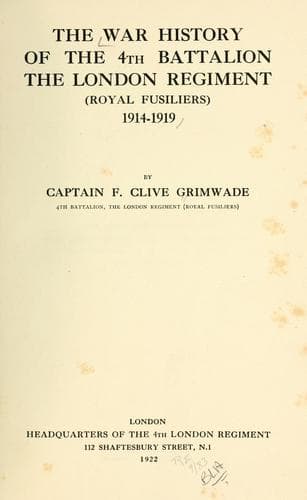
The War History of the 4th Battalion, the London Regiment (Royal Fusiliers), 1914-1919Grimwade, F. Clive
History
The War History of the 4th Battalion, the London Regiment (Royal Fusiliers), 1914-1919
Grimwade, F. Clive
Great Britain. Army. London Regiment. 4th (City of London) Battalion; World War, 1914-1918 -- Regimental histories -- Great Britain
The vital necessity of a stern British defence of the Channel Ports
was appreciated by Ludendorff as fully as by the British G.H.Q.,
and he was therefore alive to the possibility--knowing the British
inferiority in numbers--that the overwhelming importance of the north
might lead to a concentration of British divisions in the north at the
expense of the southern area. But could he be certain that this course
would be adopted? He might, after staking his all in the south, find
that British G.H.Q. had outwitted him and anticipated his intention
to attack at St Quentin. It was clearly essential that, to achieve
the sweeping victory which alone could save Germany, Ludendorff must
endeavour to encompass the temporary sterilisation of the Allied
reserves which has been alluded to. To ensure this his plans must
be shrouded in secrecy till the last moment; and the organisation
of so vast an attack as was ultimately launched without disclosing
its location to a vigilant enemy must have caused Ludendorff acute
anxiety. That it was in fact accomplished can only beget admiration
on our side for a most skilful opponent. And failure to Ludendorff,
moreover, was fraught with consequences quite as awful from his point
of view as his success would be to the British. Austria had gained a
temporary respite in its victory over the Italians, but its army was
becoming disintegrated and lacking in supplies; and no one realised
more keenly than Ludendorff that the Dual Monarchy itself could not
outlive a collapse of its army. In Germany the revolutionary ideas
from Russia were beginning to have a weakening effect on the loyalty
and steadfastness of an increasing section of the population; hunger
was becoming intensified, for the comparative failure of the U-boat
campaign resulted in an ever-tightening Allied blockade. And ever in
front of Ludendorff loomed the spectre of gigantic American forces on
their way to France, which the U-boats were powerless to stop. How many
Americans had landed? How soon could they be thrown into the battle
line to turn the scale against the Central Powers? These were questions
to which Ludendorff must earnestly have sought an answer, and which
must have brought home to him the realisation that this gigantic bid
for victory he was preparing would for good or evil be the last effort
which Germany could make.
Public-domain text, read in full here on John Shaqi.
The War History of the 4th Battalion, the London Regiment (Royal Fusiliers), 1914-1919 — John Shaqi
Reviews
Reviews
No reviews yet
Be the first to share your thoughts on this work.
Elsewhere in the archive
Join the Discussion
Join the discussion
Sign in to leave a comment or review.
Sign InorCreate an account