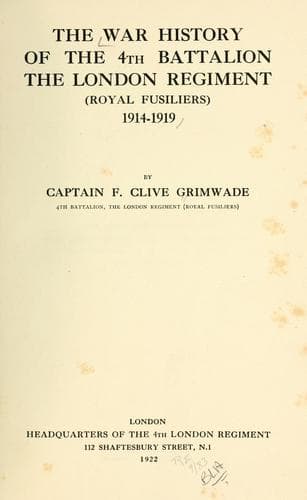
The War History of the 4th Battalion, the London Regiment (Royal Fusiliers), 1914-1919Grimwade, F. Clive
History
The War History of the 4th Battalion, the London Regiment (Royal Fusiliers), 1914-1919
Grimwade, F. Clive
Great Britain. Army. London Regiment. 4th (City of London) Battalion; World War, 1914-1918 -- Regimental histories -- Great Britain
The decision of G.H.Q. on these questions was that the Channel Ports
must be adequately defended at all costs, and that if any sector of
the line must be left weakly defended, that sector must be in the
southern area, which the Fifth Army had now taken over. The depth of
the space available for retirement in rear of the lines in this area
no doubt had its influence in this decision; and in addition, the fact
that, in the event of a considerable withdrawal of our forces under the
pressure of the German attack, a natural line of defence in rear of
the forward positions seemed to be offered in the line of the Somme,
which at Péronne makes a wide sweep southwards, thus forming a natural
barrier more or less parallel with the British front in the St Quentin
district. Possibly a further factor was the apparent natural strength
of the extreme south of the front between Moy and La Fère, where the
Oise Canal and marshes formed a wide and difficult obstacle between the
Germans and our own troops. In the southern area, moreover, it would in
case of need be more easy to make use quickly of such reserves as the
French might be able to place at G.H.Q.'s disposal.
II. _The Retreat from La Fère_
The Fifth Army was allotted a front of 42 miles, which was held by
17 divisions in line and 3 infantry and 3 cavalry divisions in
reserve. The sector was held by four Corps, from left to right the VII
(Congreve), the XIX (Watts), the XVIII (Maxse), and the III (Butler).
The III Corps, with which alone we are concerned, comprised at the
date of battle the 14th, 18th and 58th Divisions on a front of 30,000
yards, a gigantic sector for 27 battalions, not one of which was at war
strength. In reserve were the 2nd and 3rd Cavalry Divisions. The sector
allotted to the 58th Division, in which it relieved the 30th between
the 7th and 9th February 1918, was the extreme right of the British
Armies and extended from north of Travécy, where it touched the 18th
Division on the left, to south of Barisis, where it linked up with the
French on its right. This enormous front of nearly 9½ miles was held
by two brigades, the two subsectors finding their natural division in
the Oise marshes and the Canal de St Quentin, which at La Fère take a
sudden turn westward, thus running at right angles into the British
positions. North of the Canal the country is comparatively open and
gently undulating, while south of it the lines plunge through the hilly
and densely wooded district of the Forêt de St Gobain.
Public-domain text, read in full here on John Shaqi.
Reviews
Reviews
No reviews yet
Be the first to share your thoughts on this work.
Elsewhere in the archive
Join the Discussion
Join the discussion
Sign in to leave a comment or review.
Sign InorCreate an account