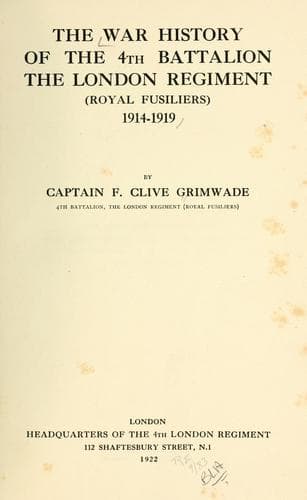
The War History of the 4th Battalion, the London Regiment (Royal Fusiliers), 1914-1919Grimwade, F. Clive
History
The War History of the 4th Battalion, the London Regiment (Royal Fusiliers), 1914-1919
Grimwade, F. Clive
Great Britain. Army. London Regiment. 4th (City of London) Battalion; World War, 1914-1918 -- Regimental histories -- Great Britain
The marsh area at La Fère is about a mile and a half wide, so that
the frontage which needed active defence by each Brigade was roughly
four miles. On so vast a frontage a defence by continuous trench lines
was clearly out of the question, and the British defence was designed
to be in great depth. It was divided into three zones of defence.
The Forward Zone, about 1000 yards in depth, relied for its defence
on small company redoubts with the space between taken up by hidden
machine-guns. This zone was intended to act as a "shock-absorber" in
which the first intensity of the enemy's onslaught might be met and
checked. The main defence was to be offered in the Battle Zone, about
1500 yards in rear of the Forward Zone. The Battle Zone occupied a
depth of about 2000 yards and was to consist of isolated and wired
forts, again strengthened by inter-supporting machine-guns. It was
hoped that a final check might be administered to the enemy's attempts
in this zone, but in rear of it a further defensive system, in this
case a continuous line, was to be created as a Rear Zone. Beyond this
again the Somme line was to be put into a state of defence.
At the date of taking over this area from the French the defensive
organisation on the lines above indicated was practically non-existent.
Very little depth was provided for in the defence and in rear of the
Forward Zone practically all was yet to be done. The Battle Zone
redoubts were inadequate and insufficiently wired, while the Rear Zone
line was merely spit-locked.
For weeks, therefore, the whole energies of every available formation,
infantry holding the line, engineers, pioneers and labour corps units
from all parts of the world, were concentrated on the enormous task of
converting the G.H.Q. scheme into a reality. Valuable time which could
have been well spent in training the infantry in defensive measures
and counter-attack, and in assimilating the new personnel which had
been brought into battalions by the reorganisation of January, was
inevitably devoted to entrenching and wiring work, wearying in itself
and trying as only work done against time can become. All ranks,
however, were sufficiently impressed by the need, and all were working
with the zeal born of a grim determination to prove themselves equal to
the demands which would be made upon them.
Public-domain text, read in full here on John Shaqi.
Reviews
Reviews
No reviews yet
Be the first to share your thoughts on this work.
Elsewhere in the archive
Join the Discussion
Join the discussion
Sign in to leave a comment or review.
Sign InorCreate an account