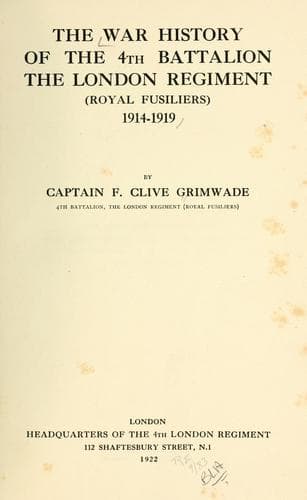
The War History of the 4th Battalion, the London Regiment (Royal Fusiliers), 1914-1919Grimwade, F. Clive
History
The War History of the 4th Battalion, the London Regiment (Royal Fusiliers), 1914-1919
Grimwade, F. Clive
Great Britain. Army. London Regiment. 4th (City of London) Battalion; World War, 1914-1918 -- Regimental histories -- Great Britain
FORWARD ZONE--2/2nd London Regiment.
Main Keep Locality: Headquarters and 1 company.
Jappy Locality: 1 company with a standing patrol at Beautor.
Brickstack Locality: 1 company.
Travécy Locality: 1 company.
BATTLE ZONE--2/4th London Regiment.
Headquarters on the Crozat Canal, Fargniers.
Fargniers South Locality: A Company (Lieut. H. J. M. Williams).
Fargniers North Locality: B Company less 2 platoons
(Capt. S. G. Askham).
Farm Rouge Locality: D Company (Capt. C. A. Clarke).
Triangle Locality: C Company (Lieut. G. E. Lester).
The two remaining platoons of B Company were detached as follows:
1 platoon (2/Lieut. D. F. Crawford) at the junction of the St
Quentin and Crozat Canals.
1 platoon (Lieut. W. F. Brown) at Condren, where there was also
a squadron of the Oxfordshire Hussars.
Quessy Locality: 1 company 1/4th Suffolks (Pioneers).
Brigade Headquarters were at Quessy Château near Crozat Canal, and
the 3rd Londons were in Divisional reserve at Viry Noureuil.
It will be seen that the bulk of the defensive force was
concentrated--if such a word may be applied to so attenuated a
defence--on the right flank, where the line of the Oise marshes, by
now practically no obstacle owing to the unusually dry spring, laid
open the road to Chauny and Noyon. It was quite evident that should the
Germans succeed in breaking through on the St Firmin-Vendeuil front
they would almost certainly endeavour to expand the breach behind
the British lines and make a south-westerly dash towards Noyon and
Compiègne in order to complete the isolation of the British armies from
the French. The Oise flank therefore was vitally important.
At 4.20 a.m. on the 21st March the enemy barrage opened with terrific
intensity. The messages to man battle positions were already written
in Brigade Headquarters, but delay was caused in conveying them to
the various units concerned, for during the first few minutes of the
bombardment Brigade Signal Headquarters were knocked out by a direct
hit, so that this and subsequent messages had to be sent by runner.
Lieut.-Col. Dann, in fact, did not receive any orders to move until
long after he had, on his own initiative, despatched his companies to
their posts.
It is rather difficult to understand why the companies were kept in
billets such as cellars under the ruins of Fargniers and Quessy until
the last moment, especially as warning of the attack had been received
the previous afternoon. Most platoons had several hundred yards, and
some as much as a mile and a half, to traverse to their trenches; and
under the intense and accurate barrage many casualties were sustained
during this forward move. By about 7.30 a.m., however, the companies
were all reported in position.
Public-domain text, read in full here on John Shaqi.
Reviews
Reviews
No reviews yet
Be the first to share your thoughts on this work.
Elsewhere in the archive
Join the Discussion
Join the discussion
Sign in to leave a comment or review.
Sign InorCreate an account