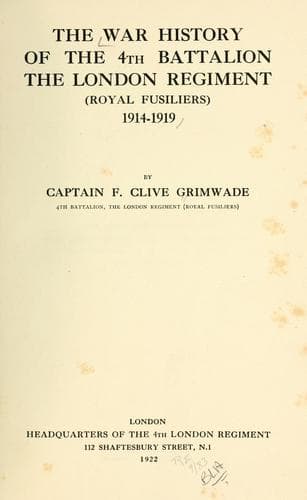
The War History of the 4th Battalion, the London Regiment (Royal Fusiliers), 1914-1919Grimwade, F. Clive
History
The War History of the 4th Battalion, the London Regiment (Royal Fusiliers), 1914-1919
Grimwade, F. Clive
Great Britain. Army. London Regiment. 4th (City of London) Battalion; World War, 1914-1918 -- Regimental histories -- Great Britain
About the same time the enemy advanced in large numbers all along
the line, especially against the Farm Rouge and Triangle Localities.
The former of these had always been regarded as a weak spot in the
defences, and two reserve machine-guns were at once turned on to the
enemy advancing against it. By 3.45 p.m., after a stubborn resistance
against overwhelming numbers, Clarke's weak company was ejected from
the Farm Rouge itself, and its grip on the remainder of the Locality
much weakened. The assaulting columns continued to press on in the
direction of the Quessy Locality, thus isolating the Fargniers position
in the corner between the two Canals and completely cutting off Lester,
who was still hanging on to his position in the Triangle against
impossible odds.
A prompt endeavour to counter this very serious turn of events was
taken by Brigade, who sent forward two platoons of the Suffolks to
reinforce Clarke and fill the gap between him and Askham. The 3rd
Londons also were drawn on again, and a second company was sent forward
through Quessy to strengthen the Farm Rouge Locality. Of this company,
however, only two platoons ever reached their objective, the others
being destroyed by the enemy's fire at the crossing of the Crozat Canal.
At about 6.50 p.m. the Battle Zone, in spite of repeated and heavy
enemy attacks, was still intact with the exceptions of the penetrations
next the Canal on the extreme right and in the Farm Rouge Locality, and
it was decided to lay down a provisional S.O.S. line on the forward
edge of the Battle Zone. The enemy, however, was continuing his attacks
with great persistence, and the gradual infiltration of his storm
troops between our scattered positions was constantly altering the
situation. By 7.15 p.m. he had already overrun the new S.O.S. line
in the vicinity of the Distillery, and was beginning to close in on
Fargniers from the south.
In the 18th Division area on the left the struggle was also raging
in the Battle Zone, though one or two posts in the Forward Zone were
continuing their glorious yet hopeless struggle. Beyond the 18th
Division the 14th had received a severe blow and the Germans had
penetrated some miles into the British positions. It appeared by no
means improbable that if the enemy's progress in this region were
unchecked the left flank of the III Corps would be entirely rolled up.
A general withdrawal was therefore inevitable to prevent the line being
broken. To conform with these movements it was decided by Division to
effect a withdrawal to the line of the Crozat Canal from its junction
with the St Quentin Canal as far north as a line running due west
between the Farm Rouge and Triangle Localities, which latter was to be
held.
Public-domain text, read in full here on John Shaqi.
Reviews
Reviews
No reviews yet
Be the first to share your thoughts on this work.
Elsewhere in the archive
Join the Discussion
Join the discussion
Sign in to leave a comment or review.
Sign InorCreate an account