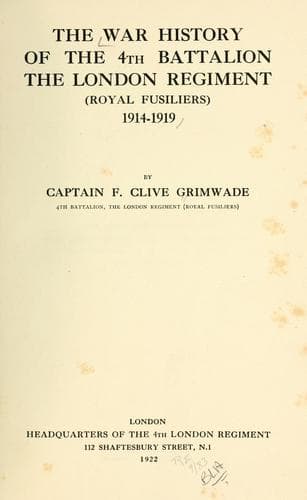
The War History of the 4th Battalion, the London Regiment (Royal Fusiliers), 1914-1919Grimwade, F. Clive
History
The War History of the 4th Battalion, the London Regiment (Royal Fusiliers), 1914-1919
Grimwade, F. Clive
Great Britain. Army. London Regiment. 4th (City of London) Battalion; World War, 1914-1918 -- Regimental histories -- Great Britain
This splendid fight, maintained till nearly 10 p.m. against hopeless
odds, was without doubt of enormous value in holding up the enemy and
inflicting severe loss on his picked troops. It also formed a strong
buttress to the flank of the 18th Division, without which they would
have found the right of their Battle Zone turned; and it gave time for
the withdrawal of the 2/4th Londons to the Canal line.
Lieut.-Col. Dann's mixed force on the Canal was of necessity in need
of organisation, and the 8th Londons, who had been in reserve at
Pierremande, were on their way to relieve the troops who had borne the
day's fighting. By 6 a.m. the relief was complete and the 8th Londons
were established on the Canal line, while Lieut.-Col. Dann's force,
consisting of the remains of the 2/2nd, 3rd and 2/4th Battalions, the
Suffolks, and elements of the 503rd Field Company R.E. and of the
182nd Tunnelling Company, who had also been thrown into the fight,
were assembled on a line west of Vouel, with Headquarters on the Butte
de Vouel. This position was an unfinished work, in parts not more
than a foot deep, and extended from the Butte almost due south to the
Chauny-Tergnier Road. Brigade Headquarters had withdrawn overnight to
Le Bas de Viry.
The Condren position, which had not been attacked on the 21st,
remained intact but was reinforced by a company of the Suffolks.
The results of the first day's fighting were tolerably serious. The
Forward and Battle Zones had been lost, and thus the greater part of
the defences which had been brought to a stage in any way approaching
completion were in the enemy's hands. The whole of the available
reserves were already inextricably in the fight, and should the attack
extend to the Southern Brigade area from Amigny-Rouy to Barisis there
would be no means of assisting the defence in that vicinity. Serious
losses of personnel had been sustained, and the swiftness and weight
of the blow had had their effect, though the morale of the troops were
still high. On the other hand the enemy had by no means gained the
success which he had anticipated. On the Brigade front of some 5000
yards, held by two weak battalions reinforced by parts of one other
battalion, he had employed nearly four divisions, and in spite of these
ridiculous odds had only advanced an average of about 5000 yards to
find that the defence had successfully withdrawn behind an obstacle
of much natural strength. The defence was shaken, but it was not in
the least broken, and a break through was the only means of ultimate
success to the Germans.
Public-domain text, read in full here on John Shaqi.
Reviews
Reviews
No reviews yet
Be the first to share your thoughts on this work.
Elsewhere in the archive
Join the Discussion
Join the discussion
Sign in to leave a comment or review.
Sign InorCreate an account