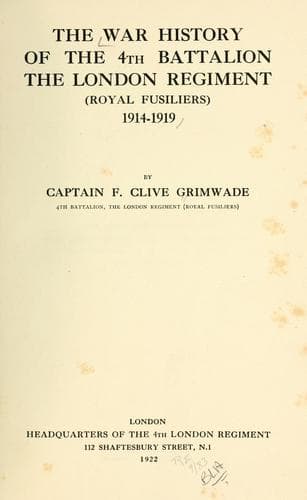
The War History of the 4th Battalion, the London Regiment (Royal Fusiliers), 1914-1919Grimwade, F. Clive
History
The War History of the 4th Battalion, the London Regiment (Royal Fusiliers), 1914-1919
Grimwade, F. Clive
Great Britain. Army. London Regiment. 4th (City of London) Battalion; World War, 1914-1918 -- Regimental histories -- Great Britain
On arrival in the Vouel line in the early hours of the 22nd March, the
Battalion, which occupied the north end of the position near the Butte,
was reorganised in three companies, with A Company under 2/Lieut. F. G.
Williams on the right, B under Capt. Askham in the centre and D under
Capt. Clarke on the left. As on the 21st, a dense mist appeared with
the early hours, and until it rose, shortly after midday, no infantry
movement took place. Under cover of the mist the Battalion was able to
do a good deal of work on the Vouel line, and in this they were not
much interfered with, as most of the German shells were falling on the
road in front.
About 1.15 p.m. the enemy attack opened with great vigour and immense
weight on the Canal line and Tergnier. The crossing of the Canal was
rendered easier to the enemy by reason of the unfortunate fact that one
or two bridges had not been entirely demolished after our withdrawal.
All had long before been prepared for demolition, but for some reason
the charges did not explode in every case. A certain bewilderment was
caused to the defenders at first as the Germans appear to have gained
their first footing west of the Canal disguised in British uniforms
stolen from the fallen men of the 2/2nd Londons. But as soon as the
8th Londons appreciated what was happening they put up a very stubborn
resistance. After getting across the Canal the Bosche seems to have
tried to extend north and south along the western bank, and in this
he was successful in the northern area. In the south, however, the
magnificent fight made by the two companies in Tergnier checked his
progress, and time after time his attacks were stopped.
During the afternoon the German 'planes were seeking for the next
position held by us, and in spite of the hasty efforts of the Battalion
to camouflage its trench, the Vouel line was soon discovered, and
ranging on it by the German batteries rapidly ensued. No infantry
attack was delivered on the Vouel line, probably on account of the
enemy's lack of success at Tergnier.
Late in the afternoon the enemy's pressure on the 8th Londons grew
almost intolerable, and little by little he was working his way
into Tergnier. It was therefore decided to vacate the position, and
after dusk the 8th Londons fell back on to the Vouel line, which
they extended to the right from the Viry-Tergnier Road as far as
the railway. The two companies in Tergnier were ably extricated by
their commander and managed to get clear across the Oise, joining the
garrison at Condren, which had not been attacked.
Public-domain text, read in full here on John Shaqi.
Reviews
Reviews
No reviews yet
Be the first to share your thoughts on this work.
Elsewhere in the archive
Join the Discussion
Join the discussion
Sign in to leave a comment or review.
Sign InorCreate an account