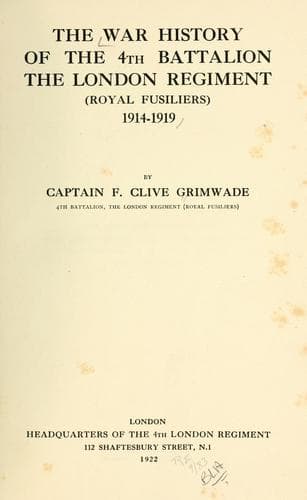
The War History of the 4th Battalion, the London Regiment (Royal Fusiliers), 1914-1919Grimwade, F. Clive
History
The War History of the 4th Battalion, the London Regiment (Royal Fusiliers), 1914-1919
Grimwade, F. Clive
Great Britain. Army. London Regiment. 4th (City of London) Battalion; World War, 1914-1918 -- Regimental histories -- Great Britain
During the afternoon, while the fate of the bulk of the Brigade was
still in the balance, and it was obviously imperative to check the
enemy's advance into Chauny by all available means, the Brigadier
ordered Major Grover of the 2/4th Londons, who was at Chauny with
battle surplus, to organise all available details for the defence of
the town. With remarkable skill and despatch Major Grover collected a
heterogeneous force of clerks, cooks, officers' servants, transport
drivers--anyone who could hold a rifle--and by dusk reported himself in
position on the eastern outskirts of Chauny with a force of 10 officers
and 270 other ranks at his command. Of these, 2 officers and 54 other
ranks were of the 2/4th Londons. This very brilliant piece of work
no doubt did much to save the situation, and "Grover's Force" beyond
question deserves to rank high among the various similar "scarecrow
armies" which these critical days produced.
During the afternoon Lieut.-Col. Dann was attached for duty to Brigade
Headquarters, and the remains of the 2/4th and 8th Londons came under
command of Lieut.-Col. Derviche-Jones of the latter Battalion.
The withdrawal from the Green line to the River Helot position was
considerably impeded by the French troops who were streaming in a
westerly direction, and Brigade therefore endeavoured to ascertain what
the intentions of the French Commander were. These were found to be to
hold a line from Viry-Noureuil to Villequier-Aumont, and accordingly
it was decided that the whole of the 173rd Brigade Group should be
withdrawn and reorganised in positions to support the French. This
reorganisation was successfully carried out. In view of the rapid and
confusing moves which had followed each other in such quick succession,
it may be well to state in detail the Brigade positions at dawn on the
24th March:
BRIGADE HEADQUARTERS AT ABBÉCOURT
GROVER'S FORCE--Covering the eastern exits of Chauny from
the St Quentin Canal to north of the
Chauny--Viry-Noureuil Road.
18TH ENTRENCHING BATTALION--Astride the St Quentin Canal
on the right of Grover's Force.
6TH DISMOUNTED CAVALRY BRIGADE--On the left of Grover's
Force east of the Chauny--Villequier-Aumont Road.
DETAILS OF THE 2/4TH AND 8TH LONDONS--On the left
of Grover's Force west of the
Chauny--Villequier-Aumont Road.
The Condren garrison substantially maintained its original positions
and was in touch by means of patrols with the 18th Entrenching
Battalion, while on the extreme right the 174th Brigade, which had not
been attacked, continued to hold the Amigny-Rouy--Barisis front.
On the left of the conglomerate force which now formed the 173rd
Brigade Group the line was continued by the 18th and 14th Divisions,
with whom French troops were interspersed in the direction of Cugny.
Public-domain text, read in full here on John Shaqi.
Reviews
Reviews
No reviews yet
Be the first to share your thoughts on this work.
Elsewhere in the archive
Join the Discussion
Join the discussion
Sign in to leave a comment or review.
Sign InorCreate an account