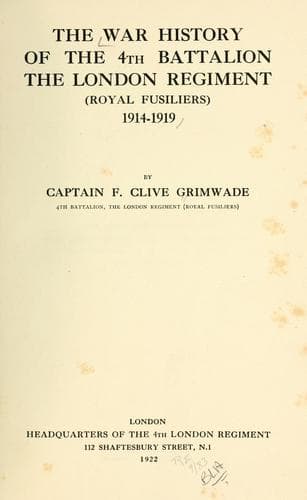
The War History of the 4th Battalion, the London Regiment (Royal Fusiliers), 1914-1919Grimwade, F. Clive
History
The War History of the 4th Battalion, the London Regiment (Royal Fusiliers), 1914-1919
Grimwade, F. Clive
Great Britain. Army. London Regiment. 4th (City of London) Battalion; World War, 1914-1918 -- Regimental histories -- Great Britain
Shortly afterwards the mist cleared and the awkwardness of the
situation became more apparent. The 18th Division were being pressed
back towards Villequier-Aumont, and the left flank was entirely in
the air, while the constant pushing of small highly trained bodies of
the enemy was enabling them to progress along the Oise marshes on the
right. Vouel itself was strongly occupied, and troops were massing for
attack. By 12 noon the position was no longer tenable. The enemy was
advancing frontally and from both flanks, and Lieut.-Col. Dann ordered
a withdrawal on to the Green line. This was a partly dug position which
formed a portion of the Rear Zone and was held by troops of the 6th
Dismounted Cavalry Brigade and the 18th Entrenching Battalion, on a
line east of Noureuil and Viry-Noureuil from the St Quentin Canal to
the Vouel-Villequier Road. The withdrawal to the Green line from the
Vouel position averaged about 1500 yards, and so hard were the enemy
pressing that some platoons had to fight their way back. An attempt
was made by the French machine-gunners in the Vouel line to cover the
Battalion's withdrawal, but this was not effective and, together with
several of our own men, they were captured.
The situation was now critical. The falling back of the 18th Division
on the left revealed a gap between the Vouel-Villequier Road and
Frières Wood of which the enemy was not slow to take advantage, and
there appeared every likelihood that the 173rd Brigade would be cut off
from the 18th Division and rolled up against the St Quentin Canal. To
meet this threat the left flank of the Green line position, consisting
of troops of the Dismounted Brigade and details of the 8th Londons,
was thrown back and extended towards Villequier-Aumont in an attempt
to gain touch once more with the 18th Division. This line was thin,
and under the continued German pressure it suffered severely. During
the afternoon the enemy thrust south again and entered Noureuil, thus
driving a wedge behind the flank of the Green line troops. A glance
at the map will show that a further withdrawal was inevitable if the
whole Brigade was not to be rounded up. This began about 6 p.m. and the
troops, including all that was left of the fighting ranks of the 2/4th
Londons, about 120 all told under Capt. Askham, fell back to a position
west of Viry-Noureuil, which village was yielded to the enemy.
Public-domain text, read in full here on John Shaqi.
Reviews
Reviews
No reviews yet
Be the first to share your thoughts on this work.
Elsewhere in the archive
Join the Discussion
Join the discussion
Sign in to leave a comment or review.
Sign InorCreate an account