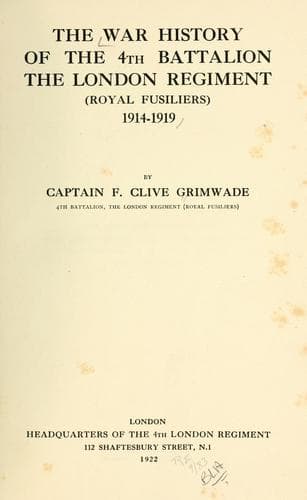
The War History of the 4th Battalion, the London Regiment (Royal Fusiliers), 1914-1919Grimwade, F. Clive
History
The War History of the 4th Battalion, the London Regiment (Royal Fusiliers), 1914-1919
Grimwade, F. Clive
Great Britain. Army. London Regiment. 4th (City of London) Battalion; World War, 1914-1918 -- Regimental histories -- Great Britain
Orders were received that the front line would be held till the last.
The support company would be employed for counter-attack purposes
in the event of the enemy gaining a footing in our positions; and
the success of the defence would clearly depend on the rapidity and
skill with which this local reserve was used. The right flank of the
Brigade front was further strengthened by the 10th Londons, who were
temporarily attached in Brigade reserve.
On the 21st the Battalion suffered a severe loss in the adjutant,
Capt. F. W. Walker, D.S.O., who was wounded, his duties being taken by
Lieut. S. A. Seys, the assistant adjutant. On the 23rd Capt. Hetley
was attached to the 131st French Divisional Headquarters as liaison
officer, and his company was handed over temporarily to Capt. W. C.
Morton.
The same day information was obtained from Alsatian deserters that the
enemy attack would take place at dawn the following morning.
We may restate the distribution of companies in the trenches as follows:
In Front-- No. 2 (Askham) on the right.
No. 1 (Morton) in the centre.
No. 4 (Grimsdell) on the left.
In Support--No. 3 (Hettler).
By an extraordinary chance the enemy was yet once more favoured by
the weather, for, when his barrage dropped on our lines at 4 a.m. on
the 24th April with bitter intensity and great accuracy, the day was
dawning on a dense mist which impeded observation beyond a radius of
about 50 yards. The bombardment was severe, and in the area of forward
battery positions included gas shell.
The attack appears to have developed at widely different hours in
different parts of the line: the S.O.S. was received from the 8th
Division on the left as early as 5.40 a.m., and from Hangard at 6 a.m.,
but it was not until 6.20 a.m. that reports indicated that the 173rd
Brigade front was generally engaged. On the 2/4th Battalion front all
was ready to receive the advancing waves of German infantry, but it
must be admitted that some of the stoutest hearts were filled with
something approaching dismay when out of the fog, at a distance of 40
to 50 yards, loomed the weird forms of German tanks. So far as can
be ascertained about six tanks were directed on the 2/4th Battalion's
sector, and it was the only Battalion of the Brigade against which
they advanced. The tanks seem to have been uncertain of their bearings
in the mist and not too skilfully handled. One at least devoted its
energies to describing small circles, firing wildly into the ground
where none of our troops were posted.
Public-domain text, read in full here on John Shaqi.
Reviews
Reviews
No reviews yet
Be the first to share your thoughts on this work.
Elsewhere in the archive
Join the Discussion
Join the discussion
Sign in to leave a comment or review.
Sign InorCreate an account