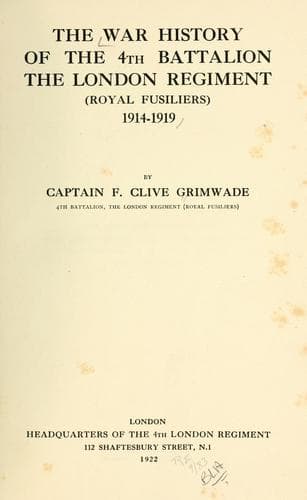
The War History of the 4th Battalion, the London Regiment (Royal Fusiliers), 1914-1919Grimwade, F. Clive
History
The War History of the 4th Battalion, the London Regiment (Royal Fusiliers), 1914-1919
Grimwade, F. Clive
Great Britain. Army. London Regiment. 4th (City of London) Battalion; World War, 1914-1918 -- Regimental histories -- Great Britain
In spite of this unskilful manœuvring, however, there is no doubt that
the sudden appearance of these monsters shook our defence for a moment,
and the men fell back a short distance. They remained perfectly under
control, and were rapidly rallied by their officers a short distance in
rear of the front trench, after which the German infantry, advancing
in three waves close behind the tanks, were hotly engaged with rifle
and Lewis gun fire, which inflicted heavy loss on them. Askham was hit
about twenty minutes after the attack began, and after his departure to
the Aid Post charge of affairs in the firing line, so far as control
was possible over a wide front in the mist, was assumed by Morton
of No. 1 Company. The first news of what was occurring in front was
received at Battalion Headquarters from Morton in a message timed 6.30
a.m.: "Tanks have crossed front line trenches, front line has fallen
back, have rallied them at Coy. H.Q. line."
Steadily the tanks pressed our line back though our retirement was
carried out gradually and at ghastly loss to the German infantry; and
finally Morton was able to collect all available men of the 2/4th
Battalion in the Cachy Switch.
The support company put up a good fight--Hettler was hit early--and
eventually was nearly surrounded; but it cut its way out and managed
also to gain the Cachy Switch. The Divisional records time our
retirement to the Cachy Switch at 7.40 a.m., but there seems no doubt
that the Battalion's resistance was much more prolonged than this would
indicate. Certainly Morton was not able to report the organisation of
his new position till 10.15 a.m. By this time only about one hundred
men of the Battalion with three subalterns, Prince, Sheppard and
Ewing, were under Morton's hand, though others rejoined later. The
2/4th Battalion's retirement had involved the risk of leaving the left
flank of the 2/2nd Londons on its right in the air, but this Battalion
conformed to our movement, though a gap ensued between the two units.
This was promptly filled by Brigade, who sent forward a company of the
2/10th Londons. By midday our line was more or less stabilised on a
line from the Cachy Switch immediately in front of Cachy village along
the Hangard Road. This meant that Hangard Wood was lost, and from the
left flank the bad news was also received that Villers-Bretonneux had
fallen into the enemy's hands.
Beyond artillery activity no further action of importance occurred on
the Battalion's front during the afternoon, which was busily occupied
in forming a line of shell hole defences in the new position and in
feeling out to the flanks to gain touch with adjoining units.
Public-domain text, read in full here on John Shaqi.
Reviews
Reviews
No reviews yet
Be the first to share your thoughts on this work.
Elsewhere in the archive
Join the Discussion
Join the discussion
Sign in to leave a comment or review.
Sign InorCreate an account