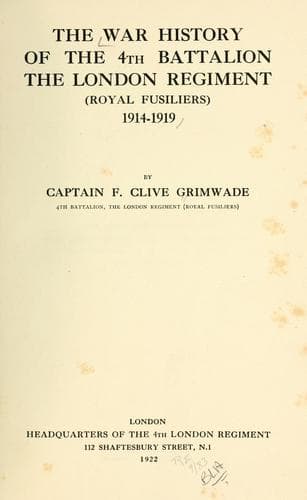
The War History of the 4th Battalion, the London Regiment (Royal Fusiliers), 1914-1919Grimwade, F. Clive
History
The War History of the 4th Battalion, the London Regiment (Royal Fusiliers), 1914-1919
Grimwade, F. Clive
Great Britain. Army. London Regiment. 4th (City of London) Battalion; World War, 1914-1918 -- Regimental histories -- Great Britain
News from the area of battle in the south was still vague, though it
was known that the Fifth Army had been forced to give a great deal of
ground, and that the Third Army on its left had also retreated, though
to a less degree, and to conform to the movements of its neighbour.
As the day wore on, however, the enemy's pressure on the Third
Army south of the Scarpe increased and by the 27th he had captured
Monchy-le-Preux. It became evident that he was aiming at a movement
to envelop Arras from the south. A reasonable deduction from this
situation was that the blow at Arras would shortly develop also on the
north of the Scarpe, by means of an assault on the Vimy Ridge.
In the early hours of the 25th March, shortly after the 1/4th Londons
had taken over the line, 2/Lieut. C. H. Board and Coy. Sergt.-Major
Matthews of B Company were visiting the sentry groups in Beatty Post
when two of the enemy, who had entered the trench by stealth, tried to
drag the Coy. Sergt.-Major out of it. A scuffle ensued in which another
officer and an N.C.O. joined. The two Germans unfortunately got away
after slightly wounding both Board and Matthews.
During the day the artillery on both sides became more active, though
no infantry action occurred, and the men were kept busy in constructing
trench blocks and improving firesteps. The right flank of the 1/4th
Londons' sector had always been regarded as a rather weak spot in the
defence, and in view of the expectation that the enemy would assault
the Vimy Ridge from the south, it was desirable to provide for the
formation by the Battalion of a defensive flank facing south should
this area become threatened. To this end work was pushed forward in
constructing and improving firesteps in Ouse Alley for its possible use
as a "switch line." This precaution, as will be seen, was justified by
events.
During the evening a report was received of the examination of a
prisoner of the 471st Infantry Regiment, who had been taken near
Mill Post on the previous evening. This was to the effect that the
attack was to be made on the morning of the 26th, and that the 219th
and 23rd Reserve Divisions had been brought forward for the purpose.
These troops were accommodated in the Drocourt-Quéant line. They
had just arrived from Riga and would attack in conjunction with the
240th and 5th Bavarian Reserve Divisions. They would assemble in
the front line system and would advance to a depth of four miles
with their right flank on Oppy, then swing round towards Vimy. Three
special divisions would capture the Vimy Ridge the next day. The 471st
Regiment had already 60 trench mortars in position, and 8 more trench
mortar companies were to arrive on the night of the 25th; most of the
ammunition was already in the line.
Public-domain text, read in full here on John Shaqi.
Reviews
Reviews
No reviews yet
Be the first to share your thoughts on this work.
Elsewhere in the archive
Join the Discussion
Join the discussion
Sign in to leave a comment or review.
Sign InorCreate an account