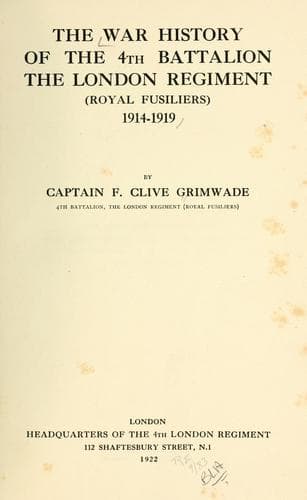
The War History of the 4th Battalion, the London Regiment (Royal Fusiliers), 1914-1919Grimwade, F. Clive
History
The War History of the 4th Battalion, the London Regiment (Royal Fusiliers), 1914-1919
Grimwade, F. Clive
Great Britain. Army. London Regiment. 4th (City of London) Battalion; World War, 1914-1918 -- Regimental histories -- Great Britain
On the 18th the 1/4th Londons were relieved by the Kensingtons and
withdrew in Brigade reserve to Roclincourt, leaving two platoons in
support attached to the Kensingtons, and one in front trenches attached
to the London Scottish. A rearrangement of the method of holding the
line was now ordered by Corps, and the necessary changes which were
effected on the night of 21st/22nd March resulted in each division
holding its sector with two brigades in line and one in reserve. Each
front line brigade had two battalions in trenches and one in support.
The effect of this in the 56th Division was to leave the 169th and
168th Brigades in the line, while the 167th was withdrawn to the
support area.
The 21st March saw the opening of the great German offensive on the
Fifth Army front, but no attack developed opposite the 56th Division.
The day was marked by very greatly increased artillery activity on the
enemy's part, gas shell being freely used on the Bailleul-Willerval
line. This indication of the imminence of active operations caused the
cancellation of the relief of the 56th Division by the 62nd. The next
day warning was received that the 2nd Canadian Division would take over
the line, but this order was also subsequently cancelled.
No definite news of the offensive was received during the 21st March,
though it was reported that the enemy had gained the high ground
near Wancourt Tower, and was likely by his assault on Monchy to lay
the Corps right flank open to attack. Arras was heavily shelled, and
all the civilians were cleared out. St Pol also was bombarded by a
long-range gun, while low-flying Bosche aeroplanes were over the lines
and at night dropped bombs on Thélus.
On the evening of the 24th the 1/4th Londons returned to the front
line. Aerial reports of great activity behind the German lines now
made it clear that the attack was imminent, and final preparations for
the struggle were completed. All spare Lewis guns and magazines were
brought up from the transport lines. The men were in splendid fettle,
and the high probability that the long weeks of suspense would shortly
be over increased their good humour. All were absolutely confident in
themselves and each other, and their only anxiety was as to whether
they would have the good fortune to be in front trenches to meet the
enemy.
At this time Gen. Loch and Lieut.-Col. Marchment made strong
representations that the three front line posts ought to be much more
lightly held, and that the Company Headquarters in Beatty should be
withdrawn to the Marquis line, on the grounds that it was useless to
pack men into posts only 100 yards from the enemy, where they were
certain to suffer severely from the hostile bombardment and where
they had no room to fight. These representations were not received
favourably by Corps though the event showed they were well founded. As
it was Lieut.-Col. Marchment moved one platoon from Oppy Post, but even
with this alteration the Marquis line was too lightly held.
Public-domain text, read in full here on John Shaqi.
Reviews
Reviews
No reviews yet
Be the first to share your thoughts on this work.
Elsewhere in the archive
Join the Discussion
Join the discussion
Sign in to leave a comment or review.
Sign InorCreate an account