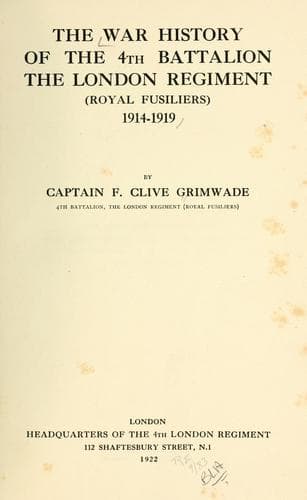
The War History of the 4th Battalion, the London Regiment (Royal Fusiliers), 1914-1919Grimwade, F. Clive
History
The War History of the 4th Battalion, the London Regiment (Royal Fusiliers), 1914-1919
Grimwade, F. Clive
Great Britain. Army. London Regiment. 4th (City of London) Battalion; World War, 1914-1918 -- Regimental histories -- Great Britain
On the night 27th/28th March orders were received that the XIII Corps
boundary was to be extended northwards as far as the Souchez River, and
that the 56th Division would "side-step" northwards. The side-step was
effected by transferring the Kensingtons from the right flank of the
1/4th Londons to the left flank, the Kensingtons taking over two new
posts north of the 1/4th Londons from the 8th Canadian Brigade. The gap
thus created on the right flank of the Battalion was filled by the
169th Brigade, which extended its left flank. Why this redistribution
was effected at the eleventh hour we do not know: obviously it must
have been for some very important reason. But whatever the cause,
the result was distinctly weakening to the defence. We have already
alluded to the well-recognised risk of the 1/4th Londons' right flank
being laid open, and now at the last moment the area was occupied by a
Battalion entirely strange to the ground. The relief in fact was not
completed before the battle opened, for when the Bosche barrage fell on
the morning of the 28th March the L.R.B. had not taken over Bailleul
East Post, while a company of the 1st Canadian Rifles in the Brown line
was still awaiting relief. By the courtesy of the Canadian Brigadier
this company was placed under the orders of Brig.-Gen. Loch.
In addition to this eleventh hour change of dispositions a certain
difficulty appears to have beset the High Command in reconciling the
rôles of the three divisions composing the Corps, and this resulted in
a stream of orders each of which altered its predecessor. The Corps
order, under which the extension of the 56th Division's line was
carried out, laid down that the Bailleul-Willerval line (Red line) was
to be the line of resistance, and that the front line system would be
regarded as outposts. Later in the evening the front line system was
ordered to be held at all costs to conform with the 4th Division on our
right; but still later a modification of this was made on the left of
the line in order to conform to the defensive line of the 3rd Canadian
Division on our left, and the garrison of Arleux Post was ordered, if
heavily attacked, to withdraw to the Arleux Loop.
The final dispositions therefore provided five lines of defence,
each to be defended at all costs in default of a Divisional order to
withdraw. There were:
1. Front line system.
2. Red line (Bailleul-Willerval).
3. Brown line (Farbus-Vimy).
4. Green line (Thélus).
5. La Targette line.
The order of battle of Brigade was as follows:
169TH BRIGADE (RIGHT):
Front line system: Queen's Westminsters in Towy Post on the right.
London Rifle Brigade in Mill,
Bradford and Bird Posts on the left.
Red line: 1/2nd Londons.
Brown line: 1 coy. 1/5th Cheshire Pioneers.
Reserve: 2 coys. 1st Londons (attd. from 167th Brigade).
168TH BRIGADE (LEFT):
Public-domain text, read in full here on John Shaqi.
Reviews
Reviews
No reviews yet
Be the first to share your thoughts on this work.
Elsewhere in the archive
Join the Discussion
Join the discussion
Sign in to leave a comment or review.
Sign InorCreate an account