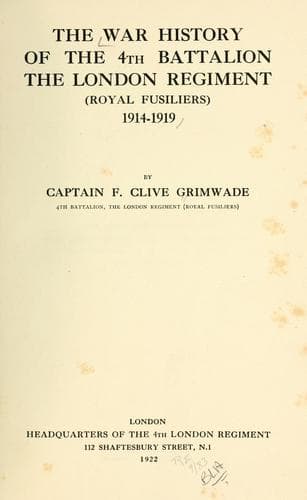
The War History of the 4th Battalion, the London Regiment (Royal Fusiliers), 1914-1919Grimwade, F. Clive
History
The War History of the 4th Battalion, the London Regiment (Royal Fusiliers), 1914-1919
Grimwade, F. Clive
Great Britain. Army. London Regiment. 4th (City of London) Battalion; World War, 1914-1918 -- Regimental histories -- Great Britain
Front line system: 1/4th Londons in Beatty, Wood and Oppy Posts
on the right.
Kensingtons in Tommy and Arleux Posts
on the left.
Red line: London Scottish.
Brown line: 2 platoons 1/5th Cheshire Pioneers.
Green line: 2 coys. 1st Londons, 1½ coys.
1/5th Cheshire Pioneers.
DIVISIONAL RESERVE:
167th Brigade (less 1st Londons) and 3 field coys. R.E.
The companies of the 1/4th Londons were disposed as follows:
Right: B Company (Spicer) H.Q. and 2 platoons in Beatty
Post. 1 platoon in Marquis and Earl line.
Centre: C Company (Duthie) 1 platoon in Wood Post. 1
platoon in Marquis line. H.Q. and 1 platoon in
South Duke St.
Left: A Company (H. N. Williams) 1 platoon in Oppy Post.
1 platoon between Oppy Post and Marquis line.
H.Q. and 1 platoon in Marquis line.
Advanced Battalion H.Q.: (Major F. A. Phillips) in South Duke
St. (with C Coy.)
Support: D Company (Cooper) in Bow Trench.
Battalion H.Q.: (Lieut.-Col. Marchment) in Ouse Alley west of
Bow Trench.
During the night 2/Lieut. R. E. Campkin with two men of C Company again
crossed No Man's Land and returned shortly before 3 a.m. on the 28th
March reporting that he had seen long lines of men carrying up to the
enemy front line what appeared to be large biscuit tins--doubtless the
trench mortar ammunition coming in. Evidently this was The Day!
At 3 a.m. on the 28th March the enemy opened an intense high explosive
shell fire on Bow Trench, Ouse Alley and Rear Battalion Headquarters,
as well as on all the rearward defensive posts. This bombardment, which
continued throughout the day, was at first mingled with mustard gas.
The forward area was hardly affected by this shelling except for the
fact that the wind carried the gas eastward over the front line posts,
the garrisons of which had to wear masks for over an hour.
At 5.40 a.m. a terrific trench mortar fire fell on the forward posts
doing very severe damage, and causing many casualties. Ouse Alley and
the Earl-Marquis line at first escaped this, though later the area of
bombardment was extended and they received a full share of it.
A strictly chronological account of an action such as this, in which
different parts of the Battalion became involved in the fight at
varying hours, is almost an impossibility if the reader is to glean
anything but the most confused impression of what occurred. We propose,
therefore, to deal first of all with the fight for the front line posts
gradually working our narrative westward.
Public-domain text, read in full here on John Shaqi.
Reviews
Reviews
No reviews yet
Be the first to share your thoughts on this work.
Elsewhere in the archive
Join the Discussion
Join the discussion
Sign in to leave a comment or review.
Sign InorCreate an account