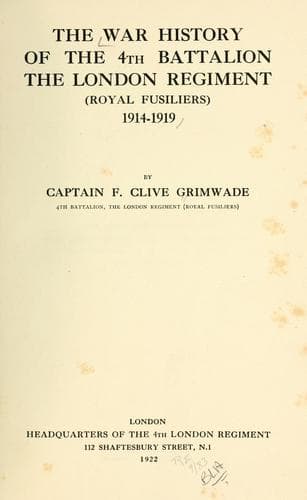
The War History of the 4th Battalion, the London Regiment (Royal Fusiliers), 1914-1919Grimwade, F. Clive
History
The War History of the 4th Battalion, the London Regiment (Royal Fusiliers), 1914-1919
Grimwade, F. Clive
Great Britain. Army. London Regiment. 4th (City of London) Battalion; World War, 1914-1918 -- Regimental histories -- Great Britain
This increasing numerical weakness of the native battalions threw a
greater burden of work and responsibility on the British units, both
Regular and Territorial, though even they experienced the greatest
difficulty in obtaining the regular supplies from home of that fresh
blood which was so earnestly desired. The 1/4th London returned from
Ypres in May at a strength well under 300 all ranks, and at no period
during the remainder of its attachment to the Indian Corps did its
strength approach even 450; in other words, for months on end, in
sentry-go, working and carrying parties, and patrols, every man was
doing two men's work; and this with a very scanty proportion of rest
behind the line. Out of 126 days from the end of May to the beginning
of October the 1/4th Londons spent 92 days in trenches, and of the
remaining 34 in billets not one was spent beyond the reach of the
enemy's guns.
With the exception of one tour of duty in the Min House Farm sector
the 1/4th Londons spent this summer on the right of the La Bassée Road
either in the trenches in front of the Rue du Bois, which included
the well-remembered positions of the Orchard Redoubt and Crescent
Trench, or in reserve, usually in Lansdowne Post, a large redoubt on
Forrester's Lane. The summer months saw very great improvements in the
Rue du Bois trenches. The isolated listening posts, like grouse-butts,
which had formed the advanced positions in March were now joined into
a continuous line of breastwork, connected with the Rue du Bois by
numerous communication trenches. Shelters for the trench garrisons
were also constructed, but these gave protection against nothing more
serious than rain--and not always that. In this waterlogged area the
sinking of a deep dugout was an impossibility, and the shelters were
in consequence mere "rabbit-hutches" built into the breastwork and
covered with corrugated iron and a few sandbags, which imbued the
occupants with an entirely unjustified sense of security. At the same
time the wire entanglements in No Man's Land were constantly extended
and strengthened. With all these defences steadily growing, the duties
of the Battalion on working parties, both when occupying the line and
when in reserve billets, were onerous and unceasing. Patrolling work by
night was vigorously prosecuted as being practically the only available
means of fostering the growth of the "offensive spirit." Trench routine
in 1915 was marked by a feature which in subsequent years almost
entirely vanished--the constant employment of rifle fire. At this
period the infantryman had not succumbed to the insensate craze for
bombs which later ruined his powers as a rifleman; and every night, in
one part of the trenches or another, saw something in the nature of an
organised shoot by the infantry, bursts of rapid fire being directed
on the enemy's parapet. These practices were of great value, not only
in keeping the men skilful with their rifles, but also in maintaining
Public-domain text, read in full here on John Shaqi.
Reviews
Reviews
No reviews yet
Be the first to share your thoughts on this work.
Elsewhere in the archive
Join the Discussion
Join the discussion
Sign in to leave a comment or review.
Sign InorCreate an account