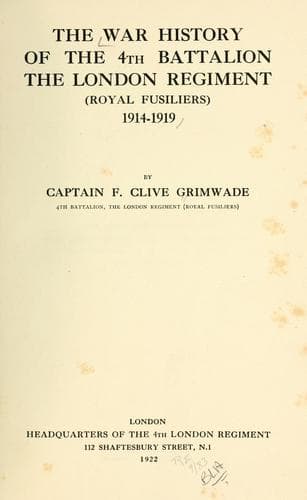
The War History of the 4th Battalion, the London Regiment (Royal Fusiliers), 1914-1919Grimwade, F. Clive
History
The War History of the 4th Battalion, the London Regiment (Royal Fusiliers), 1914-1919
Grimwade, F. Clive
Great Britain. Army. London Regiment. 4th (City of London) Battalion; World War, 1914-1918 -- Regimental histories -- Great Britain
The sudden change, therefore, from trench duty to a period of rest, in
which ceremonial mounting of guards and drill were prominent features,
created a totally new environment for the Battalion which was entirely
beneficial.
The whole Battalion, from the Commanding Officer to the most recently
arrived draft, was determined to maintain the reputation of the
Battalion; and by dint of hard work on and off parade the 4th Londons
became rapidly second to none in the Brigade in all the duties they
were called upon to carry out--and they were the more impelled to this
effort by the realisation that they were the senior Battalion of the
Brigade, not only in precedence, but also in point of active service
experience.
At Lillers the Brigade spent about a month, passed for the most part in
very cold and wet weather, in a thorough course of training, in which
particular attention was paid to drill and bombing. At this period
the question of the thorough organisation of bombing--or as they were
then called "grenadier"--sections with the proper quota of bayonet
men, throwers and carriers was attracting a great deal of thought,
and the time devoted to this particular branch of the art of war was
subsequently found, as will be seen later, to have been well spent.
Each Battalion mounted daily a quarter guard and an inlying piquet
of one officer, two sergeants, and thirty rank and file, and the
ceremonial mounting of these duties was carried cut with all possible
pomp on the Grande Place at Retreat.
In addition to this the peace-time system of "extra drills" as a minor
punishment was re-instituted--not perhaps an altogether pleasant
recollection for some--but in spite of the disadvantages such a system
must always have in the eyes of those for whose particular benefit it
is devised, there can be no question that this tightening of discipline
had in the end a beneficial effect on all ranks, the extent of which it
is impossible to overestimate.
The training period was varied by inter-battalion sports and football
matches in which the 1/4th Londons achieved some success, beating the
7th Battalion 3-1, and the 6th Battalion 3-1. On the whole the month
passed smoothly with very little incident worthy of mention beyond a
two-day divisional route march which took place on the 1st and 2nd
December.
On the 6th December the 1/4th Londons suffered a loss in the death
of Sergt. Bench, who had very efficiently carried out the duties of
Transport Sergeant since the Battalion's arrival in France, his death
being the result of injuries caused by a fall from his horse.
During the training at Lillers a most gallant action was performed by
Lieut. H. Jones. While practising throwing with live bombs one of the
men dropped a bomb with the fuse burning. At great risk Lieut. Jones
picked up the bomb and threw it out of the trench, where it at once
exploded. His bravery undoubtedly saved several lives.
In January, the Battalion was joined by Lieut. V. C. Donaldson.
Public-domain text, read in full here on John Shaqi.
Reviews
Reviews
No reviews yet
Be the first to share your thoughts on this work.
Elsewhere in the archive
Join the Discussion
Join the discussion
Sign in to leave a comment or review.
Sign InorCreate an account