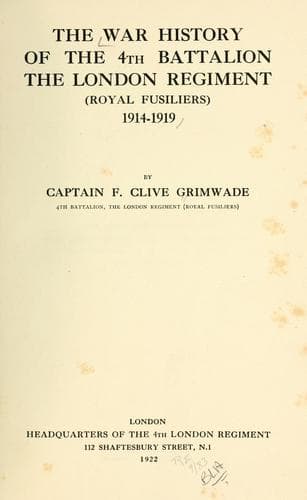
The War History of the 4th Battalion, the London Regiment (Royal Fusiliers), 1914-1919Grimwade, F. Clive
History
The War History of the 4th Battalion, the London Regiment (Royal Fusiliers), 1914-1919
Grimwade, F. Clive
Great Britain. Army. London Regiment. 4th (City of London) Battalion; World War, 1914-1918 -- Regimental histories -- Great Britain
The whole area between these confused positions was a vast maze of
earthworks, for they were in the midst of what had, prior to the
battle, been a strong German third system of defence and No Man's
Land was traversed by innumerable short communication trenches and
saps, held by the opposing garrisons by means of barricades, for the
possession of which an unceasing and murderous struggle with bombs
and trench mortars was still proceeding. In addition to these deadly
conflicts a still more subtle warfare was being waged underground,
where our Tunnelling Companies were fighting a battle of wits with the
Germans by mining and counter-mining, and the blowing of mines followed
by fierce local infantry fights for possession of the craters thus
formed were of frequent recurrence.
A reference to a large map will render clear the extreme importance to
the enemy of the possession of these two positions. Situate as they
were, one on each of the two lowest spurs of the Vermelles-Hulluch
Ridge, their capture by the British would have involved a very serious
threat to the German defences on the line Auchy-Haisnes, and might
easily have been a prelude to the outflanking of La Bassée itself.
The enemy was obviously alive to these possibilities, and the daily
intelligence reports gleaned from our patrols and observers made it
abundantly clear that he was strengthening his trenches and wire, and
was burrowing strenuously in opposition to our mining operations.
* * * * *
This severely contested part of the front was taken over by the 47th
Division from the 9th between the 13th and the 15th December, C Section
opposite the Quarries and D Section opposite the Hohenzollern Redoubt
being occupied by the 141st and 142nd Brigades, the 140th Brigade
remaining in reserve.
For some time after the return to the line the 1/4th Londons did not
enter the trenches as a battalion, but on account of its small numbers
was retained in reserve, where it performed a great deal of heavy
labour in working and carrying parties for the rest of the Brigade.
On the 15th the 1/4th Londons moved from Lillers at 8.30 a.m.,
entraining for Nœux-les-Mines, whence it marched to billets at
Labourse, training being continued while the Brigade remained in
reserve.
This move was followed by a further approach to the line which took
place on the 19th December, when the 140th Brigade relieved the 141st
in C 1 and C 2 Sections, opposite the Quarries, the 6th and 15th
Battalions occupying the front trenches with the 7th Battalion in
support at Le Philosophe and the 4th and 8th Battalions in Brigade
reserve at Noyelles-les-Vermelles.
Here the 1/4th Londons' duties in carrying and trench working parties
in the forward areas were severe as the reserve billets were some three
miles from the front line trenches.
Public-domain text, read in full here on John Shaqi.
Reviews
Reviews
No reviews yet
Be the first to share your thoughts on this work.
Elsewhere in the archive
Join the Discussion
Join the discussion
Sign in to leave a comment or review.
Sign InorCreate an account