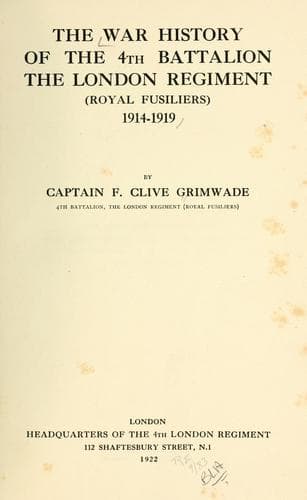
The War History of the 4th Battalion, the London Regiment (Royal Fusiliers), 1914-1919Grimwade, F. Clive
History
The War History of the 4th Battalion, the London Regiment (Royal Fusiliers), 1914-1919
Grimwade, F. Clive
Great Britain. Army. London Regiment. 4th (City of London) Battalion; World War, 1914-1918 -- Regimental histories -- Great Britain
The most active part of the Brigade's new front was C 2, the subsection
now garrisoned by the 15th Londons, where on the left of the Quarries
the continuous struggle already referred to in sapping, bombing and
mining was proceeding with particular violence. The centre of this
fighting was a work held by the British, known as the Hairpin, and
two saps, Essex Trench and Shipka Pass, which pushed forward from the
Hairpin towards the German lines. Essex Trench in particular was the
scene of much hard fighting, for the Germans were in occupation of the
further end of it and were separated from our garrison by a double
barricade. This trench and Shipka Pass were coveted by the Germans,
as it was through them that they hoped to obtain a lodgment in the
Hairpin, the possession of which would secure the right flank of their
salient at the Quarries and render their precarious tenure of that
feature much more secure. With this object they had on the night of the
17th launched a determined bombing attack along Essex Trench and Shipka
Pass, the enemy bombers being well supported by trench mortar and rifle
grenade fire. Our garrisons, however, were ready, and none of the enemy
reached our barricades, and their attack was finally dispersed by our
artillery.
This attempt was renewed in the early hours of the 20th, when so
vigorous an attack was delivered that the 15th London bombers in Essex
Trench were forced back from their barricade for some 20 yards, and
were unable for the moment to organise a counter-attack as the Germans
had constructed "arrow head" trenches flanking his sap, so that he
was able to bring fire to bear on our garrison from three points
simultaneously.
After a personal reconnaissance the Brigadier decided on making the
same evening a bid for the recovery of the lost trench. The 15th London
bombers having already suffered considerable loss, they were reinforced
during the day by the Battalion bombers of the 1/4th Londons, who
moved up to the Hairpin. The day passed quietly but for some accurate
shelling of our positions to the right of the Quarries, which was
stopped by our heavy guns. At 9.45 p.m. our attack was delivered by
three parties of bombers simultaneously--one in Essex Trench, one in a
neighbouring sap, and one moving over the open, flanking support being
given by machine-guns posted in Shipka Pass and west of the Quarries.
The first attack failed, the Essex Trench party on reaching our
old barricade coming once more under a shower of bombs from three
directions, while the sap party found progress impossible owing to
the waterlogged condition of the sap, and the party in the open were
brought to a standstill by machine-gun fire. Second and third attempts
proved equally unsuccessful, and after the 23rd December attacks were
discontinued though the enemy portion of Essex Trench was kept under
constant trench mortar fire.
Public-domain text, read in full here on John Shaqi.
Reviews
Reviews
No reviews yet
Be the first to share your thoughts on this work.
Elsewhere in the archive
Join the Discussion
Join the discussion
Sign in to leave a comment or review.
Sign InorCreate an account