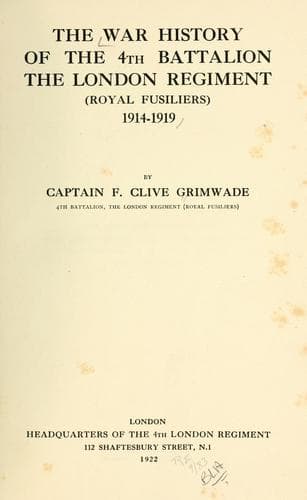
The War History of the 4th Battalion, the London Regiment (Royal Fusiliers), 1914-1919Grimwade, F. Clive
History
The War History of the 4th Battalion, the London Regiment (Royal Fusiliers), 1914-1919
Grimwade, F. Clive
Great Britain. Army. London Regiment. 4th (City of London) Battalion; World War, 1914-1918 -- Regimental histories -- Great Britain
During the 2nd, 3rd and 4th of January 1916, the relief of the 47th
Division by the Dismounted Division took place, the 140th being
relieved on the morning of the 3rd by the 1st Dismounted Brigade,
withdrawing on relief to a group of villages some seven miles behind
the line in the Béthune area, the 1/4th Londons billeting at Drouvin,
and the remainder of the Brigade being distributed between Verquin and
Mouchin.
This relief was merely the first stage of a "side-step" which the
Division was making towards the south, and on the following day the
Brigade moved _via_ Nœux-les-Mines to Les Brebis and made arrangements
for the taking over of a sector of the line south of Loos from the
French.
The 1/4th Londons' service in the Hulluch area had been arduous owing
to the long marches imposed on the working parties in addition to their
tasks, but it had fortunately, except among the bombers, not been a
costly one, and its strength had not very much decreased since the date
of its joining the Division.
During December a few officer reinforcements were received as follows:
2/Lieuts. H. G. Beal, C. W. Cragg, J. Elliott and E. W. Monk, and
during January the Battalion was joined by 2/Lieut. C. F. P. de Pury
(to D Company).
During December also the Quartermaster (Lieut. E. S. Tomsett) went on
leave during which he fell sick, not returning to the Battalion until
the 15th March 1916. In his absence his duties were carried out by
2/Lieut. S. E. H. Walmisley.
In the New Year's Honours List the names of Lieut.-Col. L. T. Burnett,
Capt. W. G. Clark, D.S.O., and Capt. J. R. Pyper were mentioned in
despatches and a few weeks later the award of the Military Cross to
Captain Pyper was announced.
The new sector taken over by the 47th Division involved relief of the
18th French Division, and a consequent extension southwards of the
British lines. This sector roughly comprised the lines in front of
the villages of Maroc and Loos, and had first been taken over from
the French in June 1915. The 47th Division had fought in this part
of the line in the battle of Loos, and carried the British positions
forward through Loos village up to the famous Double Crassier, and on
to the lower slopes of Hill 70. Subsequently the French had once more
taken the position over from them. This sector was divided into two
subsectors known respectively as Maroc and Loos, the Maroc subsector
on the right including some 1000 yards of trench extending from the
vicinity of the Grenay-Lens railway to the extreme southern limit of
the British advance in September 1915 and also about 1700 yards of the
new positions then gained; while the Loos sector comprised entirely new
positions gained in September and extended for some 1700 yards to the
left completely covering Loos village and the well-known "Tower Bridge."
Public-domain text, read in full here on John Shaqi.
Reviews
Reviews
No reviews yet
Be the first to share your thoughts on this work.
Elsewhere in the archive
Join the Discussion
Join the discussion
Sign in to leave a comment or review.
Sign InorCreate an account