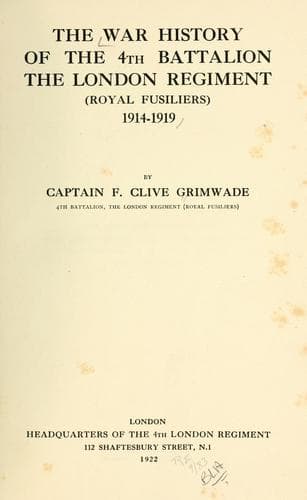
The War History of the 4th Battalion, the London Regiment (Royal Fusiliers), 1914-1919Grimwade, F. Clive
History
The War History of the 4th Battalion, the London Regiment (Royal Fusiliers), 1914-1919
Grimwade, F. Clive
Great Britain. Army. London Regiment. 4th (City of London) Battalion; World War, 1914-1918 -- Regimental histories -- Great Britain
On the night of the 5/6 January the 140th Brigade entered the Maroc
sector, the 141st occupying the Loos sector with the 142nd in
Divisional reserve. The difficulties of the relief were somewhat
increased owing to the fact of taking over French troops, and the
difference of language was the inevitable cause of some delay, but
finally, however, matters were successfully adjusted and the 140th
Brigade was left in possession with the 1/4th Londons occupying the
right subsection, on a frontage of some 800 yards opposite the "Fosse
16 de Lens"; the 7th Londons in the right-centre subsection, the 15th
Londons in the left-centre subsection, which included the Double
Crassier, and the 6th Londons on the left. The 8th Battalion were in
reserve with two companies in South Maroc, and two in the old British
front line just in rear of the Double Crassier, which was the danger
point of the Brigade sector, not only on account of the observation of
our lines which it afforded the enemy but also because it lay at the
apex of an abrupt re-entrant in the British front line.
In this sector the 1/4th Londons found their own supports which were
billeted in cellars in South Maroc, a mining village built on the
unattractive "square" plan of American cities, and consisting of
innumerable rows of artisans' dwellings, then unhappily in a state of
complete ruin. The cellars of these dwellings, however, still afforded
sufficient cover for the concentration unobserved by the Germans of a
considerable body of troops, and the Germans were evidently somewhat
disturbed at the prospect of this for their artillery, both light and
heavy, paid continual attention to the village both day and night.
This sector having once more come into occupation by British troops
an enormous amount of work was immediately necessary to complete the
front line and company supplies of small arms ammunition, bombs, rifle
grenades and trench stores of all sorts; and this support and reserve
companies were kept busily engaged in this work throughout the tour of
duty.
In this sector also the steel shrapnel helmet first made its
appearance, so far as the 1/4th Londons were concerned. It is amusing
to look back on the distrust with which its advent was first regarded
by all ranks alike--although afterwards, when once its efficiency and
protective qualities had been tested, it was as highly prized as it had
been previously shunned. The first issue was made at the rate of one
helmet per fire bay, the honour of wearing it falling to the man on
sentry duty for the time being, and most remarkably disinclined the men
were to assume this undesired badge of office.
Public-domain text, read in full here on John Shaqi.
Reviews
Reviews
No reviews yet
Be the first to share your thoughts on this work.
Elsewhere in the archive
Join the Discussion
Join the discussion
Sign in to leave a comment or review.
Sign InorCreate an account