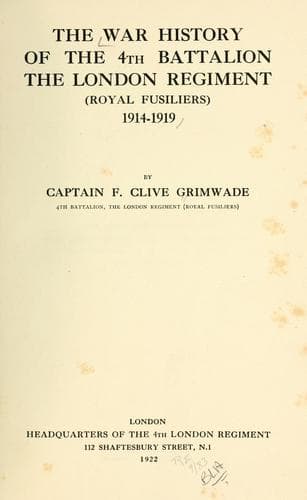
The War History of the 4th Battalion, the London Regiment (Royal Fusiliers), 1914-1919Grimwade, F. Clive
History
The War History of the 4th Battalion, the London Regiment (Royal Fusiliers), 1914-1919
Grimwade, F. Clive
Great Britain. Army. London Regiment. 4th (City of London) Battalion; World War, 1914-1918 -- Regimental histories -- Great Britain
The following day H.E. the Governor-General, General Sir Leslie Rundle,
G.C.B., G.C.V.O., K.C.M.G., D.S.O., and staff left Malta for England,
and on the 12th the new Governor-General (Field-Marshal Lord Methuen,
G.C.B., G.C.V.O., C.M.G.) arrived and took up his residence at the
Palace.
At this period occurred two events of paramount importance which
materially affected the part which the Malta Station was destined to
play in the War. The first of these was the opening on the 25th April
1915 of combined military and naval operations against the Gallipoli
Peninsula; the second being the decision to throw in her lot with the
Allies of Italy, who declared war on Austria on the 22nd May 1915.
The effect of the former of these events was to render British naval
supremacy in the Mediterranean, and consequently the security of the
Mediterranean Fleet Headquarters at Malta, of vital importance; and of
the second to ensure both desiderata not only by the relief from the
menace of a potential enemy at no great distance from the island, but
also by the accession to the Allied strength of the powerful Italian
Navy, which formed an additional protection to Malta against the
possibility of a surprise raid by Austria.
From this date onwards, therefore, the function of Malta became one not
so much of a fortress as of a base of operations, and a highly useful
evacuating station for the casualties from Gallipoli who now began to
be drafted to the island in great numbers. The accommodation on the
island for hospitals being limited to the normal service requirements
of peace time, the congestion rapidly became serious, and the troops of
the garrison vacated their barracks, going under canvas in the barrack
squares in order to provide accommodation for the sick and wounded; the
2/4th Londons moving to the parade ground at Ghain Tuffieha Camp.
On the 26th July a warning order was issued to the Battalion, which
was still regarded as a draft-finding unit to the 1/4th Battalion, to
prepare a draft of 400 other ranks to reinforce the 1/4th Battalion
in France. The resulting deficiency in the 2/4th Battalion was to
have been made up by a draft of equal size from the newly formed
4/4th Battalion in England, and although this latter draft actually
embarked at Southampton, the order was cancelled; and it appears that
the decision was made at this time, doubtless owing to the wastage
of personnel at Gallipoli, to treat the 2/4th Londons as a service
battalion and to leave the duty of provision of drafts for both the
1/4th and 2/4th Battalions to the 3/4th and 4/4th Battalions at home.
The following officers were invalided home from Malta: Major J. F. F.
Parr, R.A.M.C.T., Capt. W. G. Hayward, 2/Lieuts. L. R. Chapman and N.
L. Thomas. The Battalion was joined on the 13th August by: 2/Lieuts. B.
F. L. Yeoman, H. G. Hicklenton, C. P. Darrington and N. W. Williams.
Capt. Hayward's duties as Adjutant were taken over by Capt. L. C.
Coates.
Public-domain text, read in full here on John Shaqi.
Reviews
Reviews
No reviews yet
Be the first to share your thoughts on this work.
Elsewhere in the archive
Join the Discussion
Join the discussion
Sign in to leave a comment or review.
Sign InorCreate an account