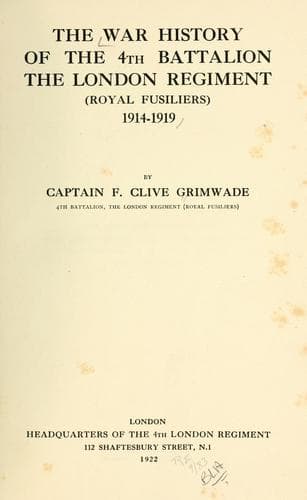
The War History of the 4th Battalion, the London Regiment (Royal Fusiliers), 1914-1919Grimwade, F. Clive
History
The War History of the 4th Battalion, the London Regiment (Royal Fusiliers), 1914-1919
Grimwade, F. Clive
Great Britain. Army. London Regiment. 4th (City of London) Battalion; World War, 1914-1918 -- Regimental histories -- Great Britain
During this period the newly arrived 16th (Irish) Division of the
New Army was attached to the 47th Division for instruction in trench
warfare, the 1/4th Londons taking over the supervision of the 8th
Munsters, among whom unfortunately several casualties were caused by
hostile shell fire on the 30th. The 31st January was marked principally
by heavy British artillery fire, which elicited but little response
from the enemy and inflicted considerable damage on his wire and
defences generally.
The following day the 140th Brigade handed over its trenches to the
142nd, the 1/4th Londons being relieved by the 21st Londons and
proceeding to rest billets in Haillicourt.
This tour of duty really brought to a conclusion the Battalion's
service with the 47th Division, for though it did not part from the
Brigade until the 9th February, the intervening days were spent in
training, route-marching and cleaning.
On the 8th Brig.-Gen. Cuthbert--then in temporary command of the
Division--inspected the 1/4th Londons prior to their departure, and
addressed the troops; and the following day the Battalion marched to
Béthune, entraining for Pont Remy (near Abbeville), and marched via
Hallencourt to Citerne, where it went into billets attached to the
168th Brigade of the newly formed 56th (London) Division, an attachment
which remained unbroken to the end of the War.
CHAPTER VII
THE 2/4TH BATTALION IN MALTA, GALLIPOLI PENINSULA AND SOUTHERN EGYPT
On the departure from Malta of the 1st London Infantry Brigade on the
2nd January 1915, the 2/1st Brigade became responsible in its place for
the defence of the Fortress.
The 2/4th Londons settled down at St George's Barracks to a vigorous
course of training. A musketry course under Fortress arrangements
was begun and also special classes for the Machine-Gun and Transport
sections, those for the latter being conducted by the A.S.C. at Musta
Fort. The Battalion also provided a detached company to continue the
duties of prisoner of war guard at Verdala Barracks, which had formerly
been carried out by a company of the 1/4th Battalion.
Shortly after the relief of the garrison, Major J. F. F. Parr,
R.A.M.C.T., who had been medical officer of the 1/4th Londons, was
appointed to be M.O. in charge of Imtarfa Hospital.
During the 2/4th Londons' duty in Malta they were frequently called
on to find the "public duties" consisting of an officer's guard at
the Governor's Palace in Valetta, and guards over various government
depôts, the first Palace Guard being found on the 9th February.
The 10th February was celebrated as a festival on the island, being the
anniversary of St Paul's shipwreck, and the usual religious procession
took place.
On the 11th February the Battalion moved from St George's Barracks to
Floriana Barracks, Valetta.
Public-domain text, read in full here on John Shaqi.
Reviews
Reviews
No reviews yet
Be the first to share your thoughts on this work.
Elsewhere in the archive
Join the Discussion
Join the discussion
Sign in to leave a comment or review.
Sign InorCreate an account