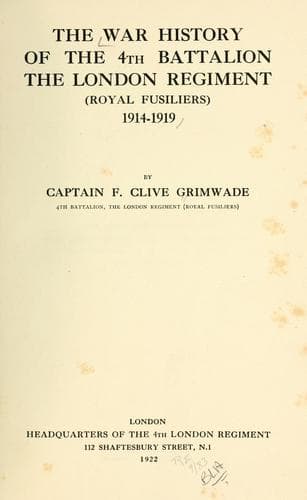
The War History of the 4th Battalion, the London Regiment (Royal Fusiliers), 1914-1919Grimwade, F. Clive
History
The War History of the 4th Battalion, the London Regiment (Royal Fusiliers), 1914-1919
Grimwade, F. Clive
Great Britain. Army. London Regiment. 4th (City of London) Battalion; World War, 1914-1918 -- Regimental histories -- Great Britain
I am proud that I have been in command of the 1st London Infantry
Brigade and am exceedingly sorry that I am not coming with you. I
had hoped that the four battalions of the London Regiment would
have gone to the Front as a Brigade.
I much appreciate the hard work you all did at Malta and I send you
from here with every confidence that you will acquit yourselves in
the future as I know you have done in the past, and you will uphold
the great reputation you have gained. I feel sure you will do great
credit to yourselves and to the City of London Regiment wherever
you go.
The commanding officer also received a letter from Major-Gen. Sir
A. Wallace, C.B., commanding the troops at Alexandria, expressing
his appreciation of the discipline and bearing of the Regiment and
affirming his conviction of the exemplary manner in which it would
carry out its duties on active service.
The same day embarkation commenced on to H.T. _Karroo_ at Alexandria,
and on the 9th, under escort of two destroyers, the _Karroo_ sailed for
Mudros, arriving on the evening of 12th October. The following officers
did not accompany the Battalion to Mudros:
Capts. G. H. Moore and H. Parkhouse (seconded for duty, in the
Censor's Office, Cairo).
Lieut. H. W. Dennis (granted leave to England) and 2/Lieut. F. R.
C. Bradford (in hospital).
For two days the Battalion remained on board in Mudros Harbour, but
on the 15th was transhipped to H.T. _Sarnia_, which put to sea about
3 p.m. At midnight the transport anchored off Cape Helles and the
Battalion disembarked on to the Gallipoli Peninsula at W. Beach and
bivouacked in dugouts in the early hours of the 16th October 1916.
The Battalion was now attached to the Royal Naval Division, the
infantry of which consisted of the following units:
ROYAL NAVAL DIVISION
Major-Gen. A. PARIS, C.B.
1ST BRIGADE--Brig.-Gen. David Mercer, C.B.
"Hawke" Battalion.
"Drake" "
"Hood" "
"Nelson" "
2/3rd London Regiment.
2/4th London Regiment.
2ND BRIGADE--Brig.-Gen. C. N. Trotman, C.B.
1st Royal Marines.
2nd Royal Marines.
"Anson" Battalion.
"Howe" "
2/1st London Regiment.
2/2nd London Regiment.
The Division was attached with the 42nd (South Lancashire) and 52nd
(Lowland) Territorial Divisions to the VIII Corps (Lieut.-Gen. Sir
Francis Davies, K.C.B.).
* * * * *
The 2/4th Londons landed on the Peninsula at a critical period in the
fortunes of the expedition, and in order to render clear the position
of affairs in the middle of October, some reference is necessary to the
course which events had taken since the inception of the campaign.
Public-domain text, read in full here on John Shaqi.
Reviews
Reviews
No reviews yet
Be the first to share your thoughts on this work.
Elsewhere in the archive
Join the Discussion
Join the discussion
Sign in to leave a comment or review.
Sign InorCreate an account