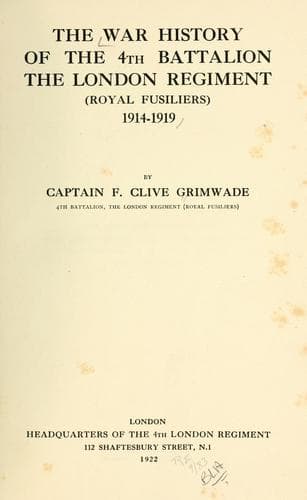
The War History of the 4th Battalion, the London Regiment (Royal Fusiliers), 1914-1919Grimwade, F. Clive
History
The War History of the 4th Battalion, the London Regiment (Royal Fusiliers), 1914-1919
Grimwade, F. Clive
Great Britain. Army. London Regiment. 4th (City of London) Battalion; World War, 1914-1918 -- Regimental histories -- Great Britain
After witnessing the "amphibious battle" between British battleships
and the land forts of the Dardanelles, which took place on the 18th
March 1915, General Sir Ian Hamilton had formed the conclusion that
the Navy would be unable to open the way to Constantinople without the
fullest co-operation of all the military forces at his disposal.
The Gallipoli Peninsula runs in a south-westerly direction from its
isthmus at Bulair, where it is spanned by fortified lines, for some
fifty-two miles to its extreme point, Cape Helles, attaining in its
centre a breadth of nearly twelve miles.
The northern coast of the northern portion slopes abruptly towards
the Gulf of Zeros in a chain of hills extending as far as Cape Suvla,
the declivitous nature of the coastline precluding serious military
landings. In the southern half, which is more accessible from the
sea, the main features consist of Achi Baba, dominating the extreme
end of the Peninsula; Sari Bair Mountain, a succession of almost
perpendicular escarpments overlooking Suvla Bay; and the Kilid Bahr
plateau protecting the forts of the Narrows against attacks from the
north coast.
As a result of a reconnaissance of this unpromising feature it became
abundantly evident to Sir Ian Hamilton that he could achieve success
and overcome the difficulties caused by the inadequacy of the landing
places and the improvements made by the Turks in their defences
since the 18th March, only by rapidly flinging ashore the largest
possible force at several landing places simultaneously. The glorious
achievement of the landings at Cape Helles and Anzac on the 25th April
are now matters of history, and lack of space makes it impossible to
repeat the epic here. We can only record the fact that in face of
innumerable difficulties and a murderous fire from the Turkish lines
and forts, landings were in fact effected. By the end of the month,
by dint of furious and practically continuous fighting, the French
and British were definitely though precariously established on the
south-west extremity of the Peninsula on a line running from sea to sea
about three miles north of Cape Helles.
It was obviously essential to exploit the initial success as quickly as
possible in order to carry the Allied lines forward before the Turkish
reinforcements should arrive, and in spite of the exhaustion of the
troops, fighting of the most desperate character continued on both the
Helles and the Anzac fronts throughout May. But so enormously strong
were the Turkish entanglements and trenches, and so well placed their
machine-guns, that the Allied progress was slow and achieved only at
appalling cost.
Public-domain text, read in full here on John Shaqi.
Reviews
Reviews
No reviews yet
Be the first to share your thoughts on this work.
Elsewhere in the archive
Join the Discussion
Join the discussion
Sign in to leave a comment or review.
Sign InorCreate an account