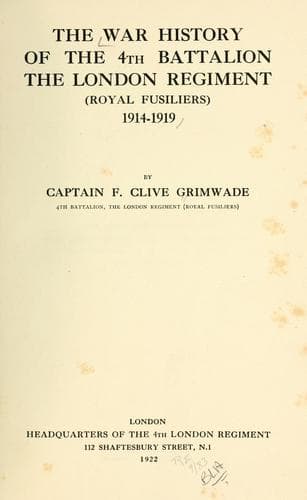
The War History of the 4th Battalion, the London Regiment (Royal Fusiliers), 1914-1919Grimwade, F. Clive
History
The War History of the 4th Battalion, the London Regiment (Royal Fusiliers), 1914-1919
Grimwade, F. Clive
Great Britain. Army. London Regiment. 4th (City of London) Battalion; World War, 1914-1918 -- Regimental histories -- Great Britain
Hitherto the Battalion had fortunately suffered but few casualties at
the hands of the enemy, the total in all ranks amounting to 4 killed
and 5 wounded. Sickness, however, now began to take a heavy toll of all
units, and this became especially serious after the 26th November, on
which day a storm of unprecedented violence burst over the Peninsula,
accompanied by torrential rain, which rapidly filled the trenches and
forced the occupants on both sides on to the parapets, where they
crouched unable to move for fear of falling into the trenches and
being swept away by the torrents which poured down them and overflowed
on to the land adjoining. In the Rest Camps the dugouts were rapidly
flooded out and the troops spent a night of bitter exposure. In the
afternoon of the following day the wind suddenly shifted to the north,
and a biting frost ensued. The cold was agonising and the water froze
around the men's feet as they slept from sheer exhaustion. Greatcoats
which had been drenched by the rains were so stiffened by the frost
that they stood up by themselves. So severe was the cold that it was
only by keeping the men constantly at work with their shovels that
many were kept alive at all. On the 28th snow began to fall, and the
blizzard continued throughout the day and during the 29th. In the
meantime the sea had become very rough and the temporary quays and
breakwaters suffered great damage, both on the Peninsula and at Mudros
and Imbros, and this added seriously to the difficulties of the already
over-burdened transport services.
During the first few days of December over 200 deaths occurred from
exposure and over 10,000 sick were evacuated from the Peninsula;
and from the statements of deserters it is probable that the Turks
suffered even more severely. A famous war correspondent who was at
Cape Helles at the time wrote: "Never probably since Crimean days have
British forces in the field had to endure such cold as the last days of
November brought to our men at the Dardanelles."
On the 29th 2/Lieut. P. C. Darrington was evacuated to hospital.[3]
[3] Darrington on recovery transferred to the 5th London Regiment
(L.R.B.) with whom he served till almost the end of the War, being
unhappily killed a few days before the Armistice.
Public-domain text, read in full here on John Shaqi.
Reviews
Reviews
No reviews yet
Be the first to share your thoughts on this work.
Elsewhere in the archive
Join the Discussion
Join the discussion
Sign in to leave a comment or review.
Sign InorCreate an account