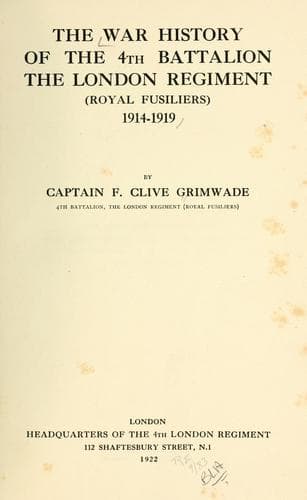
The War History of the 4th Battalion, the London Regiment (Royal Fusiliers), 1914-1919Grimwade, F. Clive
History
The War History of the 4th Battalion, the London Regiment (Royal Fusiliers), 1914-1919
Grimwade, F. Clive
Great Britain. Army. London Regiment. 4th (City of London) Battalion; World War, 1914-1918 -- Regimental histories -- Great Britain
It was not long, however, before the Battalion discovered that their
worst enemy on the Peninsula was the elements. The summer heat had now
broken and the autumn rains were beginning with all their sub-tropical
violence. The Battalion's first introduction to these deluges occurred
on the 10th November, when, having just returned from the trenches to
the Rest Camp, it was treated to a violent rainstorm which flooded all
the dugouts and shelters.
A week later when the 2/4th Londons had returned to the line a
thunderstorm burst over the lines and heavy rain fell for about two
hours, flooding many trenches and rendering them almost untenable.
This storm was followed by several days of rain and high wind which
inflicted considerable hardship on the troops, not only while they
were actually in the trenches but also by reason of the serious damage
caused to the Rest Camp, so that on coming out of the line when the
tour of duty was over the conditions of discomfort were unabated.
This sort of incident, which recurred during the rainy season with
monotonous frequency, was far more productive of discomfort and ill
effects than it would have been on the Western front; since owing to
the restriction of space it was impossible to attain on the Peninsula
to anything approaching the degree of "back-of-the-line" organisation
which was reached in France. Wet clothes, therefore, remained wet
until the sun dried them, and the inevitable result was a constantly
high proportion of sickness, which during the last few months on the
Peninsula accounted for vastly more casualties than the enemy's
weapons. But under the most unpromising circumstances the British
soldier invariably manages to make himself as comfortable as possible
and to undergo severe privations with a sort of fatalistic and stoical
cheerfulness, which he vainly endeavours to conceal by much "grousing."
And so on the Peninsula, a locality scarcely associated as a rule with
ideas of amusement, a certain amount of recreation was obtained by
football matches, and by the efforts of the bands of the four London
battalions who played in different battalion areas each evening when
the Brigades were out of the trenches. The officers also were able to
obtain some exercise through the kindness of the officers of the 2nd
Royal Fusiliers (29th Division) who lent their horses, on which a few
pleasant 'longshore excursions' were made.
The few days out of the trenches were occupied in supplying working
parties for the construction of the new winter quarters.
On the 20th November the Battalion was issued with gas masks, and
received its first instruction in defensive measures against gas
attacks. It was believed at this time that steps were being taken
by the Turks to employ poison gas against the Allies, but none was
actually used against the 2/4th Londons.
Public-domain text, read in full here on John Shaqi.
Reviews
Reviews
No reviews yet
Be the first to share your thoughts on this work.
Elsewhere in the archive
Join the Discussion
Join the discussion
Sign in to leave a comment or review.
Sign InorCreate an account