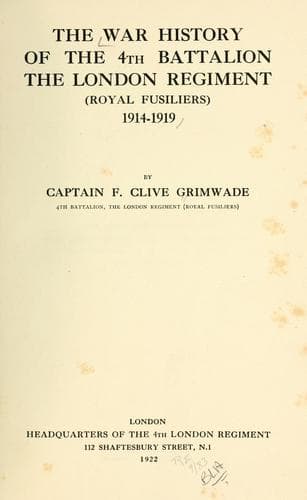
The War History of the 4th Battalion, the London Regiment (Royal Fusiliers), 1914-1919Grimwade, F. Clive
History
The War History of the 4th Battalion, the London Regiment (Royal Fusiliers), 1914-1919
Grimwade, F. Clive
Great Britain. Army. London Regiment. 4th (City of London) Battalion; World War, 1914-1918 -- Regimental histories -- Great Britain
This relief being, as already stated, carried out in the course of a
readjustment of the line, the Brigade spent only four days out of the
trenches, and on the 15th it took over a fresh sector facing Kereves
Dere on the right of Achi Baba Nullah. Of this new sector about 750
yards were taken over from the 2nd R.N. Brigade while the French troops
were relieved in about 250 yards of trench adjoining on the right. The
sector was occupied with "Nelson" on the left, and "Drake" and A and
B Companies, 2/4th Londons, on the right. Battalion Headquarters and
C and D Companies occupied the Eski line in rear of the new sector,
in this part called the Tranchée d'Amade, with one company each side
of the junction with the main communication trench, the Avenue de
Constantinople.
The days following the occupation of this sector were marked by
considerable activity on the part of the enemy's bombers. The hostile
trenches opposite the 2/4th Londons were on an overage about 70 yards
from the British front line and numerous saps had been pushed out
toward them, from the heads of which the struggle continued without
cessation, the Grenadiers on each side plying their objectionable trade
without abatement.
On the 17th B Company relieved A Company in the front trenches. Capt.
F. C. J. Read this day was evacuated to hospital, being followed there
next day by Lieut. R. C. Dickins.
On the 20th December the announcement was made in Corps orders of the
successful evacuation of the Suvla and Anzac positions which had taken
place during the night of the 19th.
The details of the scheme for this evacuation had been carefully
worked out by Sir William Birdwood who had been appointed to command
of the Dardanelles Army on the formation of the Salonika Army (Sir C.
C. Monro assuming supreme command of the Mediterranean Forces). The
scheme provided for the completion of this difficult operation in three
stages, the first of which involved the embarkation of all troops,
animals and supplies not required for a prolonged campaign; this was
to be followed by the evacuation of troops, guns, stores, etc., not
immediately required for the defence of our positions, while the third
and final stage consisted of the embarkation of the rearguard troops
and the destruction of all guns, animals and stores which could not be
removed.
The actual evacuation had been fixed for as early a date as possible
owing to the improbability of the long continuance of favourable
weather; and at both Suvla and Anzac the process was completed without
a hitch of any kind, only a small quantity of stores having to be
destroyed, and without any interference on the part of the enemy.
Almost immediately after this operation a marked increase in the
Turkish activity on the Helles front took place, probably on account of
the release of large numbers of his batteries in the evacuated sectors.
Public-domain text, read in full here on John Shaqi.
Reviews
Reviews
No reviews yet
Be the first to share your thoughts on this work.
Elsewhere in the archive
Join the Discussion
Join the discussion
Sign in to leave a comment or review.
Sign InorCreate an account