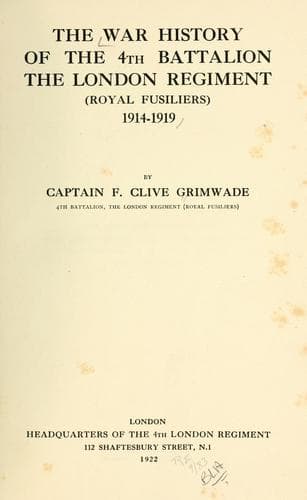
The War History of the 4th Battalion, the London Regiment (Royal Fusiliers), 1914-1919Grimwade, F. Clive
History
The War History of the 4th Battalion, the London Regiment (Royal Fusiliers), 1914-1919
Grimwade, F. Clive
Great Britain. Army. London Regiment. 4th (City of London) Battalion; World War, 1914-1918 -- Regimental histories -- Great Britain
In announcing the completion of this operation, the special order of
the day affirmed that the Helles position was not to be abandoned,
but that on the contrary the VIII Corps was entrusted with the task
of holding to this theatre of operations as large as possible a force
of Turkish troops in order to prevent their employment elsewhere. To
this end the battalions holding the line were urged to maintain their
pressure against the enemy at all points while schemes were evolved for
the construction of deep dugouts, the improvement of reserve lines,
and other works, which would only be necessary in the event of a long
continued occupation of the Peninsula.
Information was even disseminated that large reinforcements totalling
over 1600 all ranks were on the way, and were expected shortly. But
behind all these precautions against the leakage of information
among the Turks as to our intentions, and under cover of the various
fictions above described, preparations were being pressed forward for
the evacuation of the Helles front also; preparations which needed
particular care not only by reason of the greater activity of the
enemy than at Suvla and Anzac, but also because the enemy having been
successfully hoodwinked on the former occasion it hardly appeared
probable that we should be so successful a second time in masking our
intentions.
Another very severe storm broke over Cape Helles on the 21st December,
accompanied by heavy rain, and one of the 2/4th London machine-guns
was struck by lightning in the trenches. It became evident that with
the likelihood of an early complete break up in the weather the final
evacuation must not be delayed; and accordingly it was fixed for the
8th January 1916, or the first fine night after that date.
On the 21st Lieut. L. A. Dickins was seriously wounded and evacuated
from the Peninsula. This tour of duty indeed proved the most costly in
personnel which the Battalion had carried out, and among N.C.O.'s and
men 4 were killed and 13 wounded.
On the 22nd the 1st R.N. Brigade made a further "side-step" to the
right in the trenches, and in the course of the readjustment A and
B Companies of the 2/4th Londons were relieved in the trenches and
withdrew to a fresh Rest Camp, called Cæsar's Camp. The rest of the
Battalion, however, remained in the Tranchée d'Amade until after
Christmas.
On the 23rd December 2/Lieut. C. S. G. Blows joined the Battalion from
England.
Owing to the kindness of Mrs Dunfee and other ladies interested in the
2/4th Londons, Christmas gifts and cards had been received for every
member of the Battalion, and these materially helped to infuse a little
cheerfulness into a somewhat depressing and comfortless Christmastide.
On Christmas Day the Battalion was practically complete in the Tranchée
d'Amade, B Company and two platoons of A Company having moved forward
once more from Cæsar's Camp.
Public-domain text, read in full here on John Shaqi.
Reviews
Reviews
No reviews yet
Be the first to share your thoughts on this work.
Elsewhere in the archive
Join the Discussion
Join the discussion
Sign in to leave a comment or review.
Sign InorCreate an account