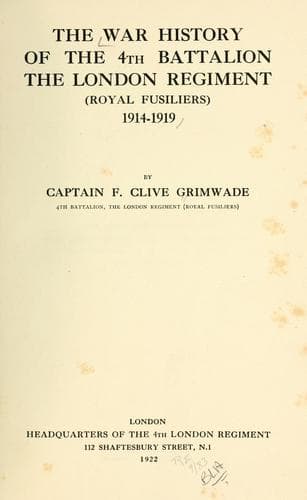
The War History of the 4th Battalion, the London Regiment (Royal Fusiliers), 1914-1919Grimwade, F. Clive
History
The War History of the 4th Battalion, the London Regiment (Royal Fusiliers), 1914-1919
Grimwade, F. Clive
Great Britain. Army. London Regiment. 4th (City of London) Battalion; World War, 1914-1918 -- Regimental histories -- Great Britain
At Mudros the connection of the 2/4th Londons with the Royal Naval
Division was severed, and they became temporarily attached to the
29th Division. A few days were spent on the island in rest and
reorganisation, and during its stay there the Battalion was rejoined by
the Transport Section and other details who had been detached from it
during its duty at the Dardanelles; and a great deal of satisfaction
was caused by the distribution of mails from home, the delivery of
which had been delayed by the evacuation.
On the 11th January Capt. R. N. Keen was admitted to hospital, and on
the 14th Sergt. F. W. Walker left the Battalion for England to take up
a commission. The record of this N.C.O. will be referred to again later
in connection with the 3/4th Battalion to which he was subsequently
attached.
The Battalion embarked on H.T. _Ionian_ for Alexandria on the 18th,
arriving there three days later. Disembarkation took place on the
following day, and the Battalion entrained to Wardan, a camping ground
near Cairo, where it took up quarters under canvas and became attached
with the other three London Battalions to the 53rd Division, Major-Gen.
A. G. Dallas, C.B., in command. At Wardan company training was carried
out until the 16th February, when the 2/4th Londons, with two companies
of the 2/2nd Londons attached, moved by rail to Beni Mazar, where it
became part of the Minia Force.
* * * * *
At the period of the 2/4th Londons' return to Egypt the Eastern
frontier, on which the Turks had attempted to force the Suez Canal
defences about a year previously, had become quiet, and the principal
cause of anxiety centred in the Western Desert where the attitude of
the Senussi, a warlike tribe of Arabs, had created a situation of
some difficulty, which was rendered more complex by the possibility
of internal disorders and religious unrest in the Nile Valley and the
Delta district.
On the outbreak of war between England and Turkey the Senussi had not
at first shown any disposition towards hostile action, but under the
influence of a Germanised Turk named Gaafer Pasha they had become more
truculent as the summer of 1915 wore on. Several breaches of the peace
which occurred in the autumn left no room for doubt that military
operations would be necessary to bring the Senussi to a due sense of
their proper behaviour.
Public-domain text, read in full here on John Shaqi.
Reviews
Reviews
No reviews yet
Be the first to share your thoughts on this work.
Elsewhere in the archive
Join the Discussion
Join the discussion
Sign in to leave a comment or review.
Sign InorCreate an account