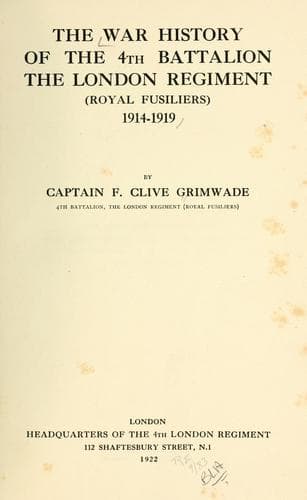
The War History of the 4th Battalion, the London Regiment (Royal Fusiliers), 1914-1919Grimwade, F. Clive
History
The War History of the 4th Battalion, the London Regiment (Royal Fusiliers), 1914-1919
Grimwade, F. Clive
Great Britain. Army. London Regiment. 4th (City of London) Battalion; World War, 1914-1918 -- Regimental histories -- Great Britain
The 8th January was calm and still, but at night the weather became
stormy, and a steady and increasing swell did not tend to facilitate
the task of rapid embarkation, and indeed rendered it very doubtful
whether it would be possible to get the last troops away at all. This
caused considerable anxiety to the Embarkation Staff whose task was
not lightened by the knowledge of the presence of an enemy submarine
which (unsuccessfully) torpedoed H.M.S. _Prince George_. Add to this
the possibility that the enemy might discover the retirement in time
to give trouble on the beaches; and it will be possible in at least a
small measure to appreciate the great skill with which this apparently
impracticable task was brought to a successful issue. By 3.30 a.m. the
evacuation was completed and at 4 a.m. two of our magazines were blown
up. The conflagration caused by these appears to have been the first
intimation of our departure received by the Turks who promptly shelled
our vacated lines heavily until 6.30 a.m.
All material was removed except a few unserviceable guns, some 500
animals and a large quantity of stores, all of which were destroyed.
It is impossible to refrain from remarking on the excellent
organisation and discipline with which the evacuation was carried out,
and also on the extraordinary luck which was vouchsafed both at Anzac
and Suvla in the concealment of the moon.
The Gallipoli expedition must live for ever in the annals of the
world's military history, as one of the most remarkable exploits ever
carried out. Although failure ensued, it was indeed a glorious failure,
and the wonder is rather that success was so nearly attained. The base
of operations at Alexandria was 800 miles distant, and the lines of
communication possessed only two inadequate and unprotected harbours
at Mudros and Imbros respectively. The whole occupied zone, and also
the sea in its vicinity, was all the time under hostile observation
and fire; there were no roads worthy of the name, no storehouses or
railways, and the activity of enemy submarines made it impossible to
send to the Peninsula any store-ship over 1500 tons.
Yet in the face of all these obstacles not only was the landing
effected, but our position maintained for nearly nine months and the
whole force safely re-embarked; and the memory of it must live for ever
as one of the greatest pages of the history of the war.
After the evacuation, an appreciative order was published in R.N.
Divisional Orders complimenting the troops on the discipline and
devotion which had sustained them during the hardships of the
campaign, and which alone had rendered the task of evacuation possible
of accomplishment. General Paris, commanding the Division, wrote
personally to the Commanding Officer a letter in which he said: "I must
thank you and your Battalion for the good work you did when with us on
the Peninsula, we all admired the cheerful spirit your men showed under
very trying circumstances."
Public-domain text, read in full here on John Shaqi.
Reviews
Reviews
No reviews yet
Be the first to share your thoughts on this work.
Elsewhere in the archive
Join the Discussion
Join the discussion
Sign in to leave a comment or review.
Sign InorCreate an account