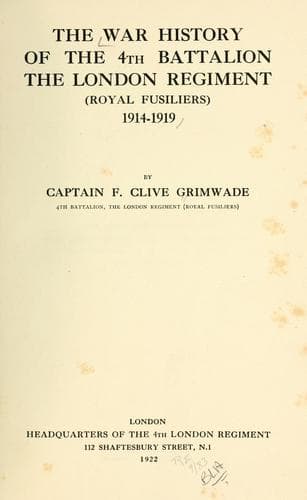
The War History of the 4th Battalion, the London Regiment (Royal Fusiliers), 1914-1919Grimwade, F. Clive
History
The War History of the 4th Battalion, the London Regiment (Royal Fusiliers), 1914-1919
Grimwade, F. Clive
Great Britain. Army. London Regiment. 4th (City of London) Battalion; World War, 1914-1918 -- Regimental histories -- Great Britain
On the 28th and 29th trial runs were made on the armoured train from
Beni Mazar to Maghaga with the double object of giving the troops
practice in rapid entrainment and of reminding the inhabitants of the
presence of British forces. A demonstration march was made through
the streets of Maghaga, but the demeanour of the natives was found to
be quite satisfactory. The behaviour of the inhabitants of Beni Mazar
also was so peaceful at this time that it was found possible to relax
somewhat the strict orders as to permitting troops to walk out in the
town, and henceforth they were allowed to walk in pairs instead of
parties of six as had formerly been the case, though side arms were
still worn at all times.
On the 1st March Capt. H. G. Stanham was appointed to command the
Saqula detachment.
The working hours of the Battalion at this period were early in the
day, owing to the advance of the hot season, but in spite of the severe
change from the trying conditions to which it had been subjected at
Cape Helles two months earlier, the Battalion showed a remarkably good
bill of health.
At the beginning of March the command in chief in Egypt was assumed by
Sir Archibald Murray, and in the rearrangement of the defensive forces
in the Nile Valley which ensued, the Beni Mazar troops ceased to form
part of the Minia Force, which was extended farther to the south, and
became attached to the Northern Force (Southern Area) under Maj.-Gen.
Dallas.
On the 3rd and 5th of March practice alarms took place and the Beni
Mazar Force moved tactically to Tambu, taking up a position there for
the defence of the railway. The strength of the 2/4th Londons on parade
at the second alarm was 16 officers and 450 other ranks.
Throughout the period of the 2/4th Londons' occupation of Beni Mazar
they received the greatest possible attention and kindness from the
local Egyptian residents, who overwhelmed them with presents of
eggs, fowls, turkeys, sheep, cigarettes, fruit and other "consumable
stores," which needless to say were gratefully received as a pleasant
alternative to rations. The officers of the Battalion were constantly
entertained by the local dignitaries, who extended to them all the
hospitality in their power, and among whom must be mentioned Mahomed
Marzouk, Mamur Markaz, Merza Mohed Ali F. Bey, Abdul Gawad, Mahomed
Zubi Abd el Razech, Ahmed H. el Keesz and H. Abd el Rezik.
On the 6th April the Saqula detachment was withdrawn and on the 12th
the Battalion left Beni Mazar, handing over duties to the 2/5th
Devonshire Regiment. The Battalion strength, 23 officers and 586 other
ranks, proceeded by train _via_ Cairo and Alexandria, travelling all
night, and detrained the following day at Sidi Gaber, marching to
quarters under canvas at Sidi Bishr. Here the 2/1st London Infantry
Brigade came together again as a Brigade for the first time since its
occupation of Malta, under the command of Col. Dunfee.
Public-domain text, read in full here on John Shaqi.
Reviews
Reviews
No reviews yet
Be the first to share your thoughts on this work.
Elsewhere in the archive
Join the Discussion
Join the discussion
Sign in to leave a comment or review.
Sign InorCreate an account