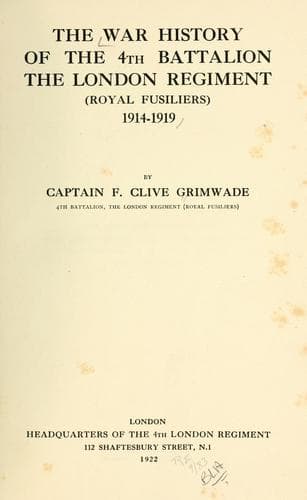
The War History of the 4th Battalion, the London Regiment (Royal Fusiliers), 1914-1919Grimwade, F. Clive
History
The War History of the 4th Battalion, the London Regiment (Royal Fusiliers), 1914-1919
Grimwade, F. Clive
Great Britain. Army. London Regiment. 4th (City of London) Battalion; World War, 1914-1918 -- Regimental histories -- Great Britain
On the 17th April the Brigade embarked at Alexandria on H.T.
_Transylvania_ which carried in addition to the Brigade, detachments
of Colonial and Imperial troops, totalling together 130 officers and
about 3000 other ranks. The following appointments were made on H.T.
_Transylvania_:
O.C. Ship--Col. Vickers Dunfee, V.D. } 2/4th London Regiment.
Ship's Adjutant--Capt. J. R. Webster }
On the 18th the _Transylvania_ left Alexandria and during the passage
all possible precautions were taken against submarine attack. No
untoward incident however occurred, and on the 24th April the transport
arrived at Marseilles and disembarkation at once took place.
The Battalion entrained immediately for Rouen, arriving on the 26th
April, and was accommodated in the Bruyères Camp.
On arrival at Rouen the 2/1st London Infantry Brigade was finally
disbanded after having been in existence for about nineteen months.
Col. Dunfee, on the break-up of the Brigade, once more assumed command
of the Battalion, but its remaining life as a separate unit proved to
be short.
The wastage which had inevitably taken place in the ranks of the 1/4th
Battalion (which had now been in France for over fifteen months) had
been far beyond the capacity of the Reserve Battalion at home to
replace; and with the certain prospect of being called on to fill
serious deficiencies to be caused by the large numbers of additional
casualties which were expected in the great battle destined to open on
1st July, it was decided by the War Office to disband finally all the
units formerly comprising the 2/1st London Infantry Brigade, and to use
these troops for the purpose of reinforcing their first line battalions.
The dispersal of the 2/4th Battalion at Rouen is therefore the last
incident to be recorded in its separate history.
Owing to the exigencies of the campaign it was impossible to grant
leave to more than a very small proportion of the Battalion in spite of
its prolonged absence from the United Kingdom, and drafts were quickly
sent up the line beginning on the 5th May. By the 20th June the whole
strength of the Battalion in officers, N.C.O.'s and men, with a few
exceptions, had been despatched to the 1/4th Londons, in the history
of which the arrival of these drafts will be noted in detail in their
place.
The officers sent to other units were:
Capts. W. H. S. Stevens and W. N. Towse, Lieut. R. C. Dickins, and
2/Lieuts. G. F. Bishop and H. W. Dennis to 1/21st London Regiment (47th
Division).
Hon. Lieut. and Q.M. J. E. W. Lambley to XV Corps, A.C.C.
A draft of 133 other ranks was sent to the Kensingtons (13th London),
but by the intervention of Lieut.-Col. Wheatley they were subsequently
secured for the 1/4th Londons. Col. Vickers Dunfee was attached to
1/22nd London Regiment (The Queens) for some two months, after which he
returned to England to command the 4th (Reserve) Battalion.
Public-domain text, read in full here on John Shaqi.
Reviews
Reviews
No reviews yet
Be the first to share your thoughts on this work.
Elsewhere in the archive
Join the Discussion
Join the discussion
Sign in to leave a comment or review.
Sign InorCreate an account