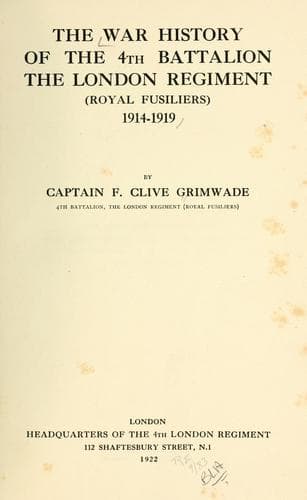
The War History of the 4th Battalion, the London Regiment (Royal Fusiliers), 1914-1919Grimwade, F. Clive
History
The War History of the 4th Battalion, the London Regiment (Royal Fusiliers), 1914-1919
Grimwade, F. Clive
Great Britain. Army. London Regiment. 4th (City of London) Battalion; World War, 1914-1918 -- Regimental histories -- Great Britain
During February 1916, recruits called up under the "Derby" scheme to
the number of 359 were posted to the Battalion and their training
proceeded with all possible speed. Owing, however, to the need for
bringing them into line with the remainder of the Battalion in view
of the possibility of its being sent to the front during 1916, the
training of these men was expedited by temporarily attaching a part of
the Battalion to the 4/4th Battalion in order to ease the duties of the
training staff.
In June the billets in Ipswich were vacated, and the Division removed
to quarters under canvas at Blackrock Camp outside the town, where the
former routine was resumed.
In these somewhat unhappy circumstances we may leave the 3/4th
Battalion and return to trace the growth of the 4/4th Battalion which
had sprung from it at Tadworth a year previously.
The following officers accompanied Major Hamilton to Headquarters and
were posted to the 4/4th Battalion: Capt. and Adjt. W. G. Hayward,
Lieut. H. E. Miller, and 2/Lieuts. W. H. Vernon and H. J. M. Williams.
Hon. Lieut. J. S. Fullalove (late Devonshire Regiment) was appointed
Quartermaster, and Coy. Sergt.-Major Potton (late 1/4th Londons) to
be Regimental Sergt.-Major. The Commanding Officer was fortunate in
enlisting into the Battalion as Warrant Officers and senior N.C.O.'s
several ex-Guardsmen and members of the City Police Force, including
Coy. Sergt.-Majors H. W. Dennis and J. Pearson, and C.Q.M.-Sergts. A.
Reed and F. Milne. These experienced soldiers formed the nucleus of
what afterwards became a very fine staff of instructors.
The new Battalion shortly after its inception became the draft-finding
unit for the first and second line battalions in the field, and also
the unit by which wounded and invalided officers, N.C.O.'s and men
of the regiment from the front were re-equipped and passed through a
"refresher" course of training, pending their return to the front as
reinforcements.
The Battalion was accordingly organised in three Companies, A and B
(respectively under Capts. W. Moore and F. C. Grimwade) being for the
reception and training of recruits; and C (under Lieut. D. C. Cooke)
being the "expeditionary" Company, the personnel being all N.C.O.'s and
men returned from the B.E.F. Lieut. F. A. Coffin succeeded Capt Hayward
as Adjutant, the latter taking over the duties of President of the
Regimental Institutes.
Public-domain text, read in full here on John Shaqi.
Reviews
Reviews
No reviews yet
Be the first to share your thoughts on this work.
Elsewhere in the archive
Join the Discussion
Join the discussion
Sign in to leave a comment or review.
Sign InorCreate an account