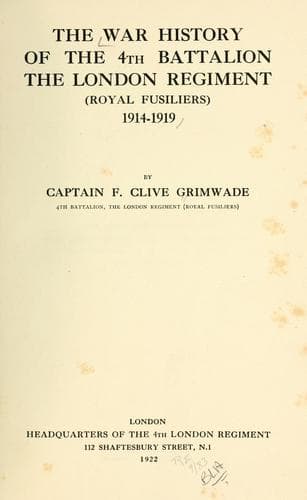
The War History of the 4th Battalion, the London Regiment (Royal Fusiliers), 1914-1919Grimwade, F. Clive
History
The War History of the 4th Battalion, the London Regiment (Royal Fusiliers), 1914-1919
Grimwade, F. Clive
Great Britain. Army. London Regiment. 4th (City of London) Battalion; World War, 1914-1918 -- Regimental histories -- Great Britain
In the following month a further move took place, and the 3/1st London
Brigade took over billets in Ipswich. A further step was now made in
the organisation of the Home Forces and towards the end of August
all personnel of the Provisional Battalion except "home-service" men
were returned to their units. The 2/2nd and 2/3rd London Infantry
Brigades had also been concentrated in the Ipswich area, and a new
Division--the 58th--was now formed as a Service Division; and the duty
of "draft-finding" for the whole Regiment henceforth devolved solely on
the 4/4th Battalion under Major Hamilton.
The composition of the 58th Division was as follows:
58TH (LONDON) DIVISION
Brig.-Gen. E. J. COOPER, C.B., M.V.O., D.S.O.
DIVISIONAL CAVALRY.
Hampshire Yeomanry (Carabineers).
ARTILLERY.
290th, 291st, 292nd, 293rd Brigades, R.F.A.
58th Division Ammunition Column.
ROYAL ENGINEERS.
2/1st Wessex}
2/2nd " } Field Companies.
1/5th London}
58th Divisional Signal Company.
173RD INFANTRY BRIGADE.
3/1st London Regiment}
3/2nd " " } (Royal Fusiliers).
3/3rd " " }
3/4th " " }
174TH INFANTRY BRIGADE.
2/5th London Regiment (London Rifle Brigade).
2/6th " " (Rifles).
2/7th " "
2/8th " " (Post Office Rifles).
175TH INFANTRY BRIGADE.
2/9th London Regiment (Queen Victoria Rifles).
2/10th " " (Hackney).
2/11th " " (Finsbury Rifles).
2/12th " " (Rangers).
1/1st Wessex Divisional Cyclists.
509th, 510th, 511th, 512th S. and T. Companies, A.S.C.
The duties of second in command were now taken by Major E. D. Wilson,
who continued to occupy this appointment for some months till he
was appointed to Brigade Staff and subsequently to Southern Command
Headquarters. He was succeeded as second in command by Capt. A. A. N.
Hayne.
The constant changes of station to which the 3/4th Battalion had
been subjected during its short existence had, as will be readily
appreciated, a somewhat deleterious effect on its training and
general discipline. Prolonged life in billets is, moreover, highly
unsuitable for young troops under training, and the general effect
of the Division's stay in Ipswich was not altogether beneficial. All
units were similarly affected. The dispatch of the Division overseas
was in consequence delayed, and the troops began to become stale with
"over-training." Throughout 1915 and the early months of 1916 this
unsatisfactory state of affairs continued, and the routine of training,
now become wearying through its monotonous repetition, was broken only
by the occasional passing excitement of air raids, of which the eastern
counties saw a good deal.
Public-domain text, read in full here on John Shaqi.
Reviews
Reviews
No reviews yet
Be the first to share your thoughts on this work.
Elsewhere in the archive
Join the Discussion
Join the discussion
Sign in to leave a comment or review.
Sign InorCreate an account